
- Home
- Comparisons
- Tidio vs Gorgias: Which Customer Support Tool Fits Your Business?
Tidio vs Gorgias: Which Customer Support Tool Fits Your Business?

Research-based comparison · not hands-on tested We compare the value each tool gives a specific kind of buyer, not which company is bigger or better, so there is no overall winner. How we compare.
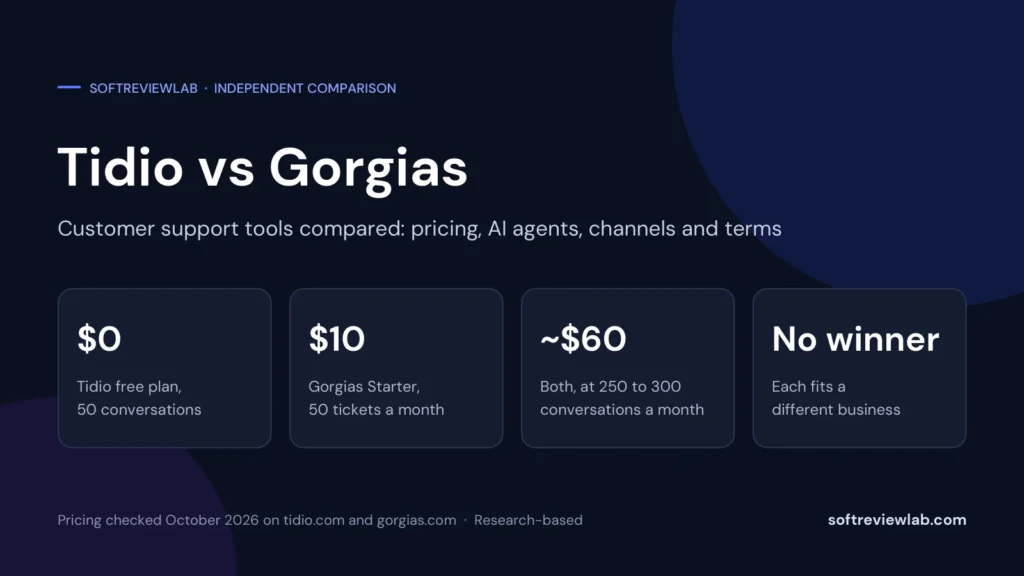
Short answer: in the Tidio vs Gorgias decision there is no overall winner, because the two tools are built for different businesses. Tidio is a live chat and AI chatbot tool that works on almost any website, has a free plan and starts at $29 a month on monthly billing. Gorgias is a helpdesk built around an online store, above all a Shopify store, with refunds and cancellations handled inside the ticket, and it starts at $10 a month for 50 tickets or $60 for 300. A small business that mainly wants chat on its website and a low starting cost gets more value from Tidio. A Shopify store with steady support volume across email, chat and social channels gets more value from Gorgias. Both charge by usage instead of by seat, and both sell their AI agent as a separate, metered cost.
Disclosure: SoftReviewLab is an affiliate partner of both Tidio and Gorgias. This page contains affiliate links, and if you sign up through them, SoftReviewLab may earn a commission at no extra cost to you. See our affiliate disclosure.
Table of Contents
Tidio vs Gorgias at a Glance
| Tidio | Gorgias | |
|---|---|---|
| What it is | Live chat, a shared inbox, no-code chatbots (Flows) and an AI agent (Lyro) for almost any website | An ecommerce helpdesk with a shared inbox, store order data and an AI Agent for support and sales |
| Built for | Small businesses and online stores on most website platforms | Online stores, above all on Shopify |
| Starting price on monthly billing | Free plan; Starter $29 for 100 conversations | Starter $10 for 50 tickets; Basic $60 for 300 tickets |
| On yearly billing | Starter $24.17 a month | Basic $50 a month; Starter is monthly only |
| How it is priced | By billable conversations, with Lyro AI and Flows as separate allowances | By billable tickets, with AI Agent, Voice and SMS charged on top |
| Free plan | Yes: 50 conversations a month and 10 seats | No |
| Free trial | 7 days, no card, then the account drops to the free plan | No card needed; 30 days on the sign-up page, 7 days on two other Gorgias pages |
| Seats | 10 on Free, Starter and Growth | 3 on Starter, 500 on Basic and above |
| AI agent | Lyro, from $39 a month for 50 AI conversations | AI Agent, from $30 a month for 30 automated interactions; needs a Shopify store |
| Phone and SMS | Not listed on the Tidio pages I checked | Add-ons from $30 (Voice) and $20 (SMS) a month, from the Basic plan |
| Refunds | No refunds for the rest of a billing period | Fees are non-refundable; 30 days’ written notice to cancel |
| My review score | 7.8 out of 10 | 7.6 out of 10 |
What Each Tool Is, in Plain English
Tidio is a customer service tool that begins with a chat bubble on your website. Messages from that bubble land in one shared inbox, together with email, Facebook Messenger, Instagram and WhatsApp. On top of the inbox it sells two kinds of automation: Flows, which are chatbots you build without code, and Lyro, an AI agent that answers questions from the content you give it. I cover it in full in my Tidio review.
Gorgias is a helpdesk made for online stores. You connect your store and your support channels, and every message becomes a ticket with the customer’s orders shown beside it. An agent can refund, cancel or edit a Shopify order without leaving the ticket. It also sells an AI Agent, plus phone and SMS support as add-ons. The full picture is in my Gorgias review.
Both are research-based assessments. I have read each vendor’s pricing, help articles and terms, and the customer ratings on public review platforms. I have not run a support desk on either tool, and I say so wherever that limits what I can tell you.
The Biggest Difference: Chat for Any Website vs a Helpdesk Built Around Your Store
The two tools start from opposite ends of the customer’s journey. Tidio starts with the visitor who is still on your site. Its strongest features are the chat widget, automated greetings and chatbots that catch a question before the person leaves. It works whether your site runs on WordPress, Shopify, WooCommerce or something else, and whether you sell products or services.
Gorgias starts with the order. Its strongest features appear after someone has bought: where is my parcel, I want to return this, please change my address. The agent sees the order next to the message and can act on it in the same screen. That is worth a lot to a store that answers the same order questions every day, and worth very little to a consultant, a clinic or a software company.
So before you compare prices, answer one question: is most of your customer contact a conversation with a visitor, or a request about an order? The first points to Tidio. The second points to Gorgias.
Tidio vs Gorgias Pricing
Neither tool charges per person on your team, which already sets them apart from most helpdesks. Both charge for volume instead. The meters are not the same, though, and that is where the real cost difference sits.
Tidio Pricing
| Plan | Monthly billing | Yearly billing, per month | Conversations included | Seats |
|---|---|---|---|---|
| Free | $0 | $0 | 50 a month | 10 |
| Starter | $29 | $24.17 | 100 a month | 10 |
| Growth | From $59 | From $49.17 | From 250, up to 2,000 | 10 |
| Plus | From $300, plus usage | From $300, plus usage | Custom | Custom |
| Premium | Contact sales | Contact sales | Custom | Custom |
Two add-ons sit on top of the plan. Lyro, the AI agent, starts at $39 a month on monthly billing for 50 AI conversations, with tiers up to 1,000. Flows start at $29 a month for chatbots that reach 2,000 visitors, with tiers up to 100,000. The free allowance for Flows is 100 visitors a month. The full list is on Tidio’s pricing page.
Gorgias Pricing
| Plan | Monthly billing | Annual billing, per month | Tickets included | Seats |
|---|---|---|---|---|
| Starter | $10 | Monthly billing only | 50 a month | 3 |
| Basic | $60 | $50 | 300 a month | 500 |
| Pro | $360 | $300 | 2,000 a month | 500 |
| Advanced | $900 | $750 | 5,000 a month | 500 |
| Custom plan | Quoted by sales | Quoted by sales | More than 5,000 | Quoted by sales |
Gorgias also has add-ons. AI Agent adds $30 a month for 30 automated interactions on Starter and Basic, $190 for 190 on Pro and $530 for 530 on Advanced. Voice starts at $30 a month and SMS at $20, and neither is offered on Starter. Extra tickets cost $0.40 each on Starter, $40 per 100 on Basic and $36 per 100 on Pro and Advanced. The details are on Gorgias’s pricing page.
What Counts Towards Your Bill
This is the part most buyers skip, and it changes the bill more than the plan price does. Tidio’s pricing page says a conversation becomes billable once a human agent replies to it or starts it. Conversations handled only by Lyro or by a Flow are counted against those add-ons, not against your plan. One Tidio help article describes the counting differently, so check your own account in the first week.
Gorgias counts more broadly. Its billing help article says a ticket is billable as soon as any message is sent from the helpdesk, whether by a person, by AI Agent or by an automatic Rule. An auto-reply that acknowledges every incoming email turns each one into a billable ticket.
The two tools also behave differently when you reach your limit. In Tidio, automatic upgrades are switched on by default and move you to the next tier when you reach 95% of a quota. If you switch them off and hit the limit, Tidio’s help center says incoming messages can’t be viewed or answered until the allowance resets. Gorgias keeps you working and charges for each extra ticket instead. One protects you from a surprise bill at the cost of going silent. The other keeps you answering at the cost of a higher invoice.
What You Would Really Pay: Worked Examples
| Situation | Tidio | Gorgias |
|---|---|---|
| About 50 conversations a month, no AI | Free plan: $0 | Starter: $10 |
| About 100 conversations a month, no AI | Starter: $29 | Starter plus 50 extra tickets: $30, or Basic: $60 |
| About 250 to 300 conversations a month, no AI | Growth: from $59 for 250 conversations | Basic: $60 for 300 tickets |
| The same volume with an entry AI bundle | Growth plus Lyro: from $98, with 50 AI conversations | Basic plus AI Agent: $90, with 30 automated interactions |
| About 2,000 conversations a month | The top Growth tier, priced by Tidio’s slider, or Plus from $300 plus usage | Pro: $360 |
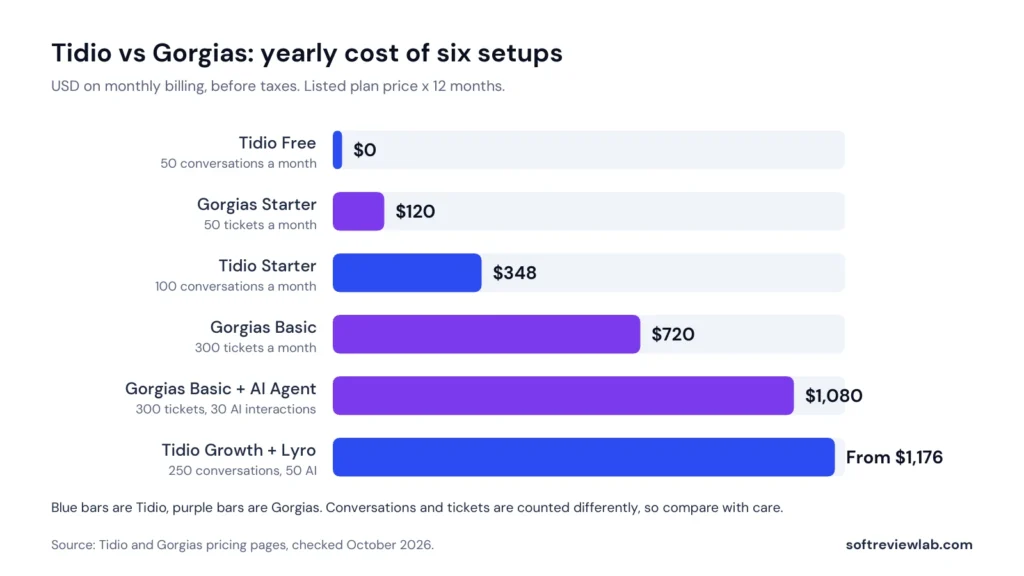
Three things stand out. At the very bottom, Tidio is cheaper because it has a free plan and Gorgias does not. Around 250 to 300 conversations a month the plan prices are almost identical, so the decision there is about what the money buys, not what it costs. And per conversation, Gorgias’s included allowance is slightly cheaper: about 20 cents a ticket on Starter and Basic and 18 cents on Pro and Advanced, against 29 cents on Tidio Starter and about 24 cents at the entry Growth tier.
Costs That Are Easy to Miss
- Tidio has three separate meters: conversations, Lyro AI conversations and Flows visitors. A store that wants all three pays for all three.
- Tidio’s automatic upgrades are on by default, so decide on day one whether they stay on.
- Tidio’s 50 free Lyro conversations are a one-off allowance that never resets.
- Gorgias bills every ticket you reply to, including replies sent by an automatic Rule.
- Gorgias has nothing between Basic at $60 and Pro at $360, so a store that outgrows 300 tickets pays per extra ticket until the jump makes sense.
- Gorgias’s AI Agent, Voice and SMS are all charged on top of the helpdesk plan.
Free Plan and Free Trial
Tidio has a free plan with no time limit: 10 seats, 50 conversations a month, ticketing, the Messenger, Instagram and WhatsApp connections, and Flows that reach 100 visitors a month. New accounts also get a 7-day trial of the paid features with no card, and Tidio says the account drops to the free plan when the trial ends, so forgetting to cancel costs nothing. If you want to start there, this is Tidio’s website.
Gorgias has no free plan. It offers a free trial with no credit card, but its own pages disagree on the length: the sign-up page says 30 days, while its plan guide and Shopify App Store listing say 7. Its subscription agreement adds that a card added during the trial is charged the day after the trial ends unless you cancel first. If Gorgias sounds closer to what you need, this is the Gorgias free trial sign-up page.
For a business that is not sure it needs a support tool at all, Tidio’s free plan is the lower-risk way to find out. For a store that already knows its ticket volume, the Gorgias trial gives you time to test with real orders, as long as you check the end date in your account on day one.
Channels: Where Customers Can Reach You
| Channel | Tidio | Gorgias |
|---|---|---|
| Website live chat | Yes, on every plan | Yes, on every plan |
| Yes | Yes | |
| Facebook Messenger and Instagram | Yes, including the free plan | Yes |
| Yes | Yes | |
| SMS | Not listed on the pages I checked | Add-on from $20 a month, from the Basic plan |
| Phone | Not listed on the pages I checked | Voice add-on from $30 a month, from the Basic plan |
If your customers call you, or you want to text them about an order, only Gorgias brings that into the same inbox, and only from its $60 plan with a paid add-on. If chat, email and social messages cover how people reach you, both tools do the job, and Tidio does it on its free plan.
Store Platforms and Order Handling
Tidio is the more flexible of the two about where your site lives. Its integrations page lists Shopify, WordPress, WooCommerce and Adobe Commerce among more than 100 integrations, and Tidio says it shows live product and order data for Shopify stores. Because the widget is added to a website and is not tied to a store platform, a service business with no shop at all can use it just as well.
Gorgias is narrower and deeper. Its pricing page lists Shopify and WooCommerce on every plan, BigCommerce from Basic and Magento from Pro. For Shopify, its helpdesk page describes refunding, cancelling and editing orders from inside a ticket. That is the feature that saves a store’s support team the most time, because it removes the constant switch to the store admin.
From what each vendor publishes, Tidio brings order information into the conversation, while Gorgias goes further and lets the agent act on the order. If refunds and cancellations are a daily job for you, ask Tidio exactly what its Shopify integration can change, because I did not find that spelled out.
AI Agents: Lyro vs Gorgias AI Agent
Both tools sell an AI agent that answers customers without a person, and both keep it outside the base plan price. They differ in what they need, what they can do and how you pay.
| Tidio Lyro | Gorgias AI Agent | |
|---|---|---|
| Works with | Any site that runs Tidio; product catalogues from Shopify or WooCommerce | Requires a connected Shopify store |
| Channels | Live chat, Messenger, Instagram, WhatsApp and email tickets | Email, chat, SMS, Instagram, Messenger and WhatsApp |
| Learns from | Website pages, FAQ pages, your own question-and-answer pairs, uploaded files and product catalogues | Help center articles, website content, documents, written guidance and Shopify data |
| Can take actions | Smart Actions, such as looking up an order; the first Action is free | Actions such as cancelling an order, processing a return or updating an address, from the Basic plan |
| Languages | 47 | More than 80 |
| Entry price on monthly billing | $39 for 50 AI conversations | $30 for 30 automated interactions |
| What you are charged for | Each conversation in which Lyro replies | Each interaction resolved without a person |
| Free allowance | 50 conversations, once | None listed |
| The vendor’s own claim | Solves up to 67% of customer problems | Resolves 60% of support tickets |
How Each One Is Billed
This is the most important difference between the two. Tidio counts a Lyro conversation the first time Lyro replies in a thread, whether or not it solves the problem. Gorgias counts an automated interaction when the AI handles the conversation and no person is needed within 72 hours. Put simply, Tidio charges for the attempt and Gorgias charges for the result.
The unit prices reflect that. Lyro’s entry tier works out at 78 cents a conversation on monthly billing. Gorgias lists $1.00 per automated interaction on Starter, $0.90 on Basic and Pro, and $0.85 on Advanced. Tidio is cheaper per conversation, but you also pay for the ones Lyro could not finish. Gorgias costs more per unit, and there is an open question on top: its help center says a ticket resolved by AI also carries the normal ticket fee, while its pricing article says you are not charged twice. Get that answer in writing before you rely on the AI for volume.
What the Vendors Claim, and What I Can Confirm
Tidio says Lyro can solve up to 67% of customer problems. Gorgias says its AI Agent resolves 60% of support tickets. Both are the vendors’ own figures, I have measured neither, and “up to” describes a best case. One detail tells you more than either headline: Tidio puts a guaranteed 50% Lyro resolution rate in writing only on its Premium plan. I found no written guarantee on Gorgias’s pages.
With both tools the result depends on the content you feed the AI. Write down your return, shipping and refund policies first, then test with real customer questions and read every answer. You can read each vendor’s own description on Tidio’s Lyro page and Gorgias’s AI Agent page. My guide to choosing AI tools for a small business covers the questions to ask of any AI product.
One note on data. Tidio’s help center says Lyro is powered by Claude, an AI model from Anthropic. Gorgias’s list of sub-processors includes OpenAI, and its subscription agreement says it can use customer data to improve its own AI models but not to train outside providers’ models. If your customers’ messages are sensitive, ask both vendors what can be switched off.
Automation Without AI: Flows vs Rules and Macros
Tidio’s Flows are chatbots built from triggers and steps, with no code: greet a visitor who lingers on the pricing page, collect an email address, reply to a missed chat. They are aimed at the front of the customer’s journey, and at sales as much as support. Tidio meters them by the number of visitors they reach.
Gorgias’s automation is aimed at the ticket queue. Macros are saved replies that fill in customer and order details. Rules tag, route or answer tickets automatically. They save agent time, but remember that an automatic reply makes the ticket billable.
If you want a tool that starts conversations with visitors, Flows do that. If you want a tool that clears a queue of order questions faster, macros and rules are the better fit.
Integrations
Tidio lists more than 100 integrations, including Shopify, WordPress, HubSpot, Salesforce, Pipedrive, Zendesk, ActiveCampaign and Zapier. Its OpenAPI is held back for the Plus plan. Gorgias’s count depends on which of its pages you read: 300+ on the homepage, 150+ on the pricing page and 100+ on the helpdesk page. Its pricing page lists an API on every plan at 2 requests per second, and its Shopify App Store listing names Aircall, Attentive, Klaviyo, Recharge and Yotpo among its partners.
The pattern matches everything else in this comparison. Tidio connects to general business tools such as CRMs. Gorgias connects to the apps a Shopify store tends to run, such as subscriptions, product reviews and email marketing. Write down the three or four apps you depend on and check each one by name before you start a trial.
Support and Onboarding
Neither vendor publishes response times for its smaller plans. Tidio’s plan comparison lists support by email on Starter and Growth and by live chat only from Plus, where a dedicated success manager also appears. Gorgias ties support to the plan: a tier it calls Community on Starter, Standard on Basic, Specialist with one-to-one onboarding on Pro, and Dedicated with a success manager and a service level agreement on Advanced.
On the plans most small businesses will buy, both tools are self-serve. You set the tool up yourself and get help through the standard channels. Fast support is among the most-mentioned positives in Tidio’s G2 reviews, which is encouraging but is not a published commitment. Send each vendor a real question during your trial and time the answer.
Contracts, Cancellation and Refunds
| Tidio | Gorgias | |
|---|---|---|
| Refunds | None for the rest of a billing period | Fees are non-refundable |
| Notice to cancel | No notice period found on the pages I checked | 30 days’ written notice before the term ends, on monthly and annual plans alike, although the pricing page says cancel anytime |
| After a free trial | The account drops to the free plan, with no automatic charge | A card on file is charged the day after the trial ends |
| Price changes | The terms allow changes at any time | At renewal, with 60 days’ notice |
| Changing plan | Automatic upgrades are on by default | No downgrade in the middle of a term |
Both vendors keep your money once you have paid, so the same advice applies to each: start on monthly billing and move to yearly only when your volume is steady. Gorgias’s terms are the stricter of the two on notice. Tidio’s are the looser of the two on price changes. The sources are Tidio’s terms and Gorgias’s Master Subscription Agreement.
Security and Data
Tidio’s FAQ states SOC 2 Type II certification, GDPR and CCPA compliance, and participation in the EU–US Data Privacy Framework. It says all data is stored in the European Economic Area and encrypted in transit and at rest, with single sign-on on the Premium plan.
Gorgias’s security page lists a SOC 2 Type II report, hosting on Google Cloud Platform, two-factor authentication and single sign-on for Google and Microsoft accounts on every plan. Its sub-processor list shows hosting in the United States, the European Union and Australia, and its data processing agreement commits to telling you about a breach within 72 hours.
For a business with mostly European customers, Tidio’s EEA-only storage is the simpler answer to give someone who asks where their data lives. For a team that wants sign-in through Google or Microsoft without paying for a top plan, Gorgias includes it from the start.
What Customers Say
| Platform | Tidio | Gorgias |
|---|---|---|
| G2 | 4.6 out of 5 (1,962 reviews) | 4.6 out of 5 (582 reviews) |
| Capterra | 4.7 out of 5 (590 reviews) | 4.6 out of 5 (135 reviews) |
| Shopify App Store | 4.7 as shown on Tidio’s own site; not checked on the App Store | 4.3 out of 5 (705 reviews) |
| Trustpilot | 3.6 out of 5 (226 reviews), rated Average | 2.1 out of 5 (152 reviews), rated Poor |
On G2 and Capterra the two are level, and both score well. Tidio’s most-mentioned positives are ease of use, fast support, its AI chatbots and easy setup. Gorgias reviewers also praise ease of use, along with its integrations, and their complaints centre on a learning curve, limits in custom reporting, charges for add-ons and overall cost.
Trustpilot is where they part. Tidio scores 3.6 and has replied to 66% of its negative reviews. Gorgias scores 2.1, Trustpilot notes that it has not invited customers to review it recently, so the sample may not be representative, and it has replied to 13% of its negative reviews. I would not let a few hundred Trustpilot reviews outweigh thousands elsewhere, but for either tool the recent one-star reviews are worth ten minutes before you sign an annual plan, because they show what happens when billing or support goes wrong.
How the Two Scored in My Reviews
| Criterion | Tidio | Gorgias |
|---|---|---|
| Setup and ease of use | 9.0 | 8.0 |
| Features | 8.5 | 9.0 |
| Pricing and value | 6.5 | 6.0 |
| Integrations | 8.0 | 8.5 |
| Support and terms | 7.0 | 6.5 |
| Overall | 7.8 | 7.6 |
The gap of 0.2 between the overall scores is too small to mean anything, and I would not choose on it. The rows are more useful. Tidio is easier to start with and a little kinder on value and terms. Gorgias goes deeper on features and on the integrations a store needs. Which of those matters more depends on your business, not on the tools.
Pros and Cons of Each Tool
Tidio Pros and Cons
What works
- A free plan with 10 seats, ticketing and 50 conversations a month.
- Works on most website platforms, with or without an online store.
- Live chat, email, Messenger, Instagram and WhatsApp in one inbox.
- No-code Flows and the Lyro AI agent in the same tool.
- A 7-day trial that drops to the free plan and does not bill you automatically.
- Data stored in the European Economic Area.
What doesn’t
- Three separate meters, so the real cost sits well above the Starter price.
- Automatic upgrades are on by default and raise your bill near a limit.
- With upgrades off, messages over the limit can’t be seen or answered.
- A large jump from Growth to Plus at $300 a month plus usage.
- No refunds, and the terms allow price changes at any time.
- No phone or SMS channel on the pages I checked.
Gorgias Pros and Cons
What works
- Shopify order details and order actions inside the ticket.
- Email, chat, social messages, SMS and phone in one inbox.
- 500 seats from the Basic plan, so a growing team does not raise the bill.
- AI Agent is charged per resolved interaction and can act on orders.
- Single sign-on for Google and Microsoft accounts on every plan.
- A slightly lower cost per included ticket than Tidio’s cost per conversation.
What doesn’t
- No free plan.
- Nothing between Basic at $60 and Pro at $360.
- Every replied ticket is billable, including automatic Rule replies.
- AI Agent needs a Shopify store.
- Fees are non-refundable, with 30 days’ written notice to cancel.
- Its own pages disagree on trial length and AI billing, and its Trustpilot score is 2.1.
Real-World Scenarios: Which Tool Fits?
A New Online Store With a Few Questions a Week
Start on Tidio’s free plan. Fifty conversations a month covers a store at this stage, it costs nothing, and you learn what your customers actually ask before you pay anyone. Gorgias’s $10 Starter plan is also cheap, but it gives you 50 tickets with 3 seats and none of the AI Actions, so there is little reason to pay for it this early.
A Service Business That Wants Chat on Its Website
Tidio is the closer fit. A consultancy, clinic, agency or local service firm has no orders to refund, so Gorgias’s main strength goes unused. What this business needs is a chat widget, a shared inbox and perhaps a chatbot that collects contact details out of hours, and that is Tidio’s home ground.
A Shopify Store Answering About 300 Order Questions a Month
Here the plan prices are almost the same: Tidio Growth from $59 against Gorgias Basic at $60. The difference is the work. If most of those 300 messages are about deliveries, returns and address changes, Gorgias saves agent time on every one by putting the order action in the ticket. If most are pre-sale questions from visitors, Tidio’s chat and Flows do more for you.
A WooCommerce Store That Wants an AI Agent
Tidio. Gorgias’s helpdesk supports WooCommerce on every plan, but its help center says AI Agent requires a connected Shopify store. Lyro can learn from a WooCommerce product catalogue and does not depend on the store platform.
A Growing Brand With Phone Support and 2,000 Tickets a Month
Gorgias is built for this. Its Pro plan lists 2,000 tickets for $360 a month, with one-to-one onboarding, revenue reporting, phone and SMS add-ons and room for a large team. Tidio can reach this volume through the top of its Growth plan or its Plus plan from $300 plus usage, but I found no phone channel on its pages, and its strengths lie earlier in a business’s growth.
Mistakes to Avoid
- Comparing the plan prices and ignoring the meters. Tidio’s add-ons and Gorgias’s per-ticket billing decide the real bill.
- Choosing Gorgias for its AI Agent when your store is not on Shopify.
- Leaving Tidio’s automatic upgrades on without knowing they are on.
- Setting up an auto-reply Rule in Gorgias that makes every incoming email a billable ticket.
- Paying yearly for either tool before you have one full month of real volume. Neither refunds unused time.
- Judging either AI agent by the vendor’s resolution claim instead of your own test with real questions.
Other Options to Consider
If neither tool fits, these are the names worth a look. I have not reviewed them yet, so check their current pricing pages before you compare.
- Zendesk and Freshdesk: general-purpose helpdesks priced per agent. They suit businesses that are not online stores, or small teams with a very high ticket count, where paying per ticket costs more.
- Help Scout: a shared inbox with a simpler feature set, often chosen by service businesses and software companies.
- Re:amaze and Richpanel: helpdesks aimed at online stores, like Gorgias.
- A shared mailbox and your store admin: for a business with a few enquiries a week, this still works, and Tidio’s free plan is the smallest step up from it.
If you are still deciding whether an AI support tool makes sense at all, start with my guide to choosing AI tools for a small business. My buyer’s guide to AI customer support chatbots compares how eight vendors charge for their AI agents.
Tidio or Gorgias: Which Should You Choose?
Choose Tidio If
- You want to start free and pay only when your volume grows.
- Your website is not an online store, or it runs on a platform other than Shopify.
- Most of your contact is with visitors who have not bought yet.
- You want chatbots that greet visitors and collect leads without code.
- You want an AI agent and you are not on Shopify.
- Your customers are mostly in Europe and you want their data stored there.
Choose Gorgias If
- You run a Shopify store and most of your support is about orders.
- You want refunds, cancellations and address changes handled inside the support screen.
- You need phone or SMS in the same inbox as email and chat.
- You answer about 300 tickets a month or more, with several people sharing the work.
- You want an AI agent that can act on orders and that is billed when it resolves the conversation.
Use Neither If
- You get a handful of enquiries a month and a shared mailbox copes.
- You need the option of a refund if the tool does not work out. Neither vendor offers one.
- You support business customers with contracts and response-time commitments, where a per-agent helpdesk is usually the better match.
Tidio vs Gorgias: My Verdict
Tidio vs Gorgias is not a contest between a good tool and a bad one. They are two sound tools aimed at different jobs. Tidio gives a small business a free, quick way to put chat, a shared inbox and an AI agent on almost any website. Gorgias gives an online store, above all a Shopify store, a support desk where the order and the actions on it sit beside every message.
Around 250 to 300 conversations a month they cost almost the same, so price should not decide it. Decide on the work instead. If your team mostly talks to visitors, Tidio gives you more for the money. If your team mostly fixes orders, Gorgias does.
Both share the same weak spots: usage meters that make the real bill higher than the headline price, AI sold as an extra, and no refunds. Whichever you pick, test both in the same week, since Tidio has a free plan and Gorgias a no-card trial. Sort last month’s messages into pre-sale questions and order questions, give both AI agents the same real questions, and count the billable conversations or tickets after a week before you choose a plan. Then start on monthly billing and get the unclear points in writing. You can open an account from Tidio’s website or the Gorgias free trial sign-up page. My full Tidio review and Gorgias review cover each tool in more depth.
Frequently Asked Questions
Is Tidio better than Gorgias?
Neither is better overall. Tidio is the closer fit for small businesses that want live chat and chatbots on almost any website, with a free plan to start. Gorgias is the closer fit for Shopify stores whose support is mostly about orders, because agents can refund, cancel and edit orders inside the ticket.
Which is cheaper, Tidio or Gorgias?
It depends on volume. At about 50 conversations a month Tidio is free and Gorgias costs $10. At about 100, Tidio Starter is $29 and Gorgias works out at about $30 with extra tickets. At 250 to 300 a month they are almost level, at $59 and $60. Per included conversation, Gorgias is slightly cheaper. In both tools the AI agent costs extra.
Which AI agent costs less, Lyro or Gorgias AI Agent?
Lyro costs less per unit: $39 a month for 50 AI conversations, or 78 cents each, against $30 for 30 automated interactions on Gorgias’s Starter and Basic plans. But the two are counted differently. Tidio charges for every conversation in which Lyro replies. Gorgias charges for interactions the AI resolves without a person.
Which is better for a small Shopify store?
For a store with a few questions a week, Tidio’s free plan is enough and costs nothing. Once you answer a few hundred order questions a month, Gorgias’s order actions inside the ticket start to save real time. The switch point is less about size than about how much of your support involves changing orders.
References
Every fact in this comparison comes from the pages below, checked in October 2026. Prices and terms change, so confirm the current figures on each vendor’s own pages before you buy.
- Tidio pricing page
- Tidio FAQ
- Tidio terms
- Tidio help: the monthly conversations limit
- Tidio help: the Lyro AI agent limit
- Tidio help: automatic upgrades
- Tidio help: Lyro, the conversational AI agent
- Tidio integrations page
- Gorgias pricing page
- Gorgias plan guide: choose your plan
- Gorgias help: how you are billed
- Gorgias help: AI Agent explained
- Gorgias AI Agent pricing article
- Gorgias Master Subscription Agreement
- Gorgias help: cancel an account
- Gorgias security page
- Gorgias list of data sub-processors
- Gorgias on the Shopify App Store
- G2, Capterra and Trustpilot review pages for both tools (named, not linked)
- How SoftReviewLab reviews and scores software
- SoftReviewLab editorial and affiliate policy
What we couldn’t verify
- Neither tool was tested hands-on, so ease of use, speed and support quality are based on each vendor’s documentation and on customer reviews.
- How accurately Lyro and Gorgias AI Agent answer real customer questions was not measured; the 67% and 60% figures are the vendors’ own claims.
- Tidio’s price for Growth tiers above 250 conversations is set by a slider on its pricing page and is not listed here.
- Whether Tidio offers phone or SMS channels, and what its Shopify integration can change on an order, was not found on the pages checked.
- Gorgias’s own pages differ on the trial length (30 or 7 days) and on whether a ticket resolved by AI carries both a ticket fee and an automation fee.
- Tidio’s own pages differ on when a conversation becomes billable and on how a Lyro conversation is counted.
- Tidio’s notice period for cancelling was not found on the pages checked.
- Neither vendor publishes support response times for its smaller plans.
- The Shopify App Store rating for Tidio is the figure shown on Tidio’s own site.
If any of these matter to your decision, check them directly with the vendors or during a free trial.
See every matchup
Browse the rest of the head-to-head comparisons, or jump straight to the full reviews.