

How to Track Sales Leads for Free: A Simple System for Small Businesses
Leads get lost when they are spread across inboxes, phones and memory. Here is how to track sales leads for free in one list,…
By Abdullahi Abdirahman, Founder & Editor, SoftReviewLab. Updated November 2026.
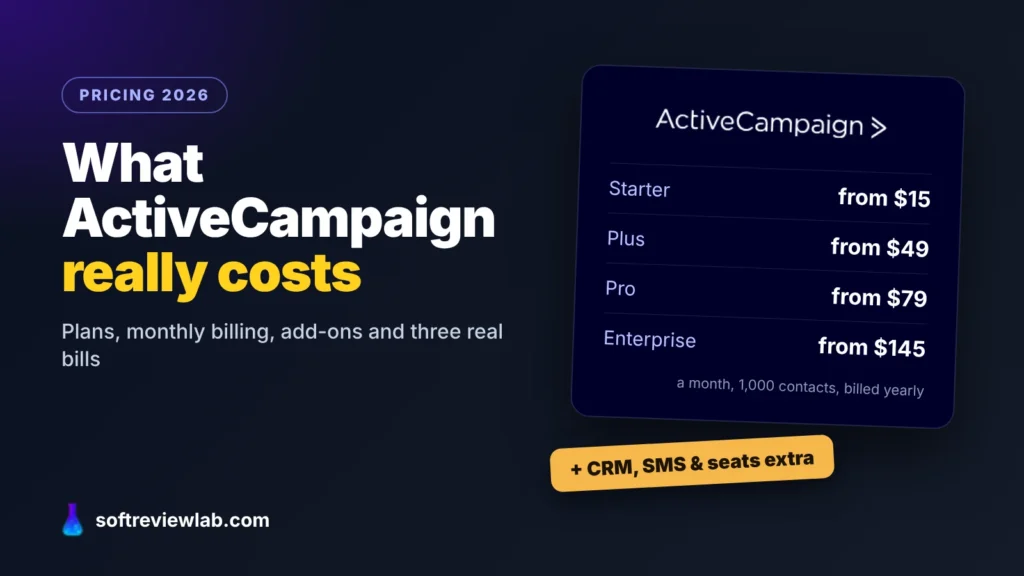
Short answer: ActiveCampaign pricing starts at $15 a month for 1,000 contacts on the Starter plan, but that price is billed for a whole year up front. Month-to-month billing costs more, is available only on Starter and Plus, and has to be requested from support. Your real bill also depends on three things the pricing page does not show you: how many contacts ActiveCampaign counts, whether you need the sales CRM or SMS add-ons, and how many people need a login. For a small business that only sends email, Starter or Plus is the real cost. Add a CRM and a second user, and the same account can cost more than twice as much.
Disclosure: SoftReviewLab is an ActiveCampaign affiliate, so we may earn a commission if you sign up through some links on this page, at no extra cost to you. The prices below come from ActiveCampaign’s pricing page, its billing page inside an account and written answers from its support team, all in October 2026. See our affiliate disclosure.
ActiveCampaign sells four email plans: Starter, Plus, Pro and Enterprise. Each one is priced by the number of contacts you store, and the pricing page shows every plan at 1,000 contacts first:
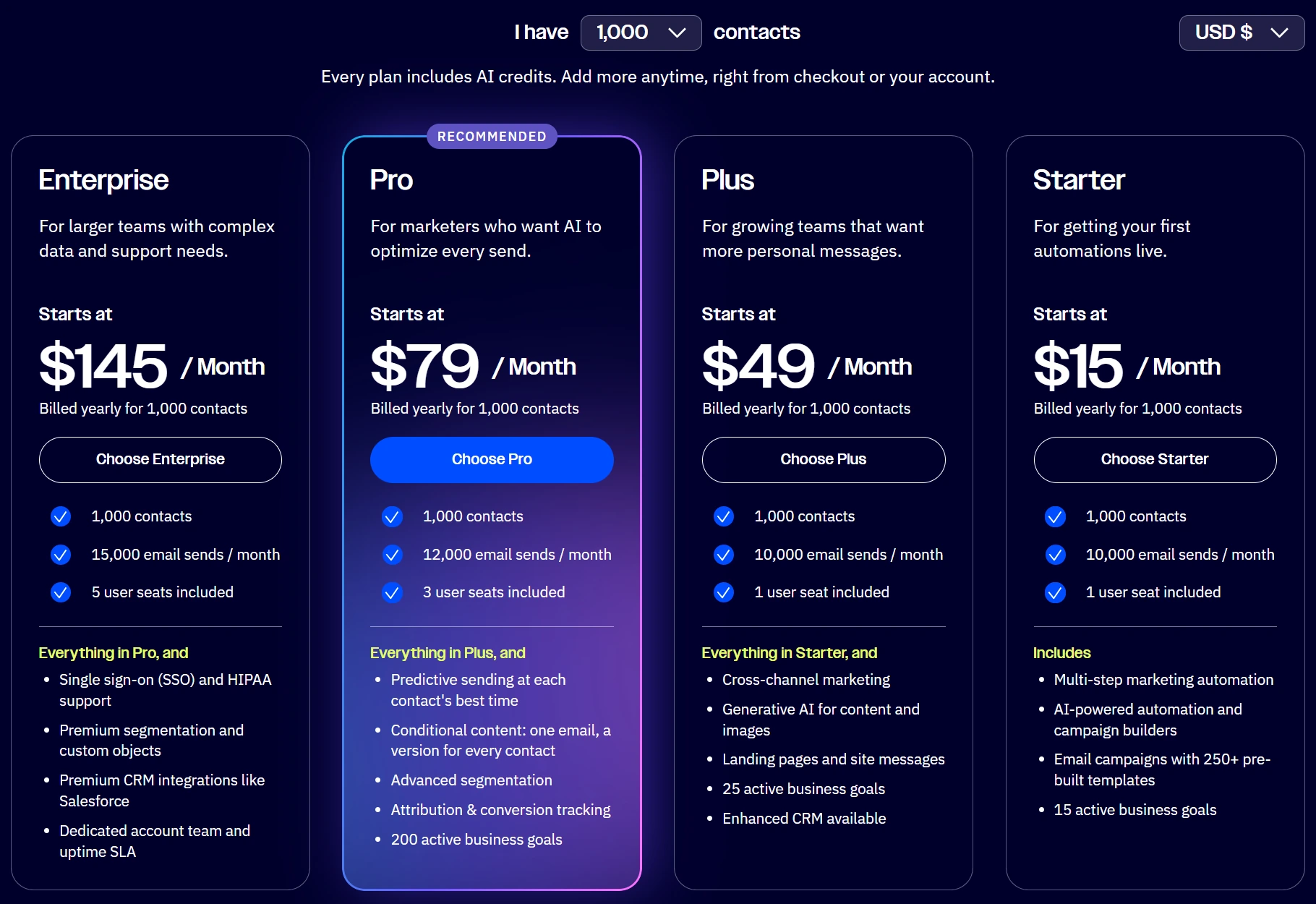
The contact selector at the top of the page changes all four prices at once. These are the yearly-billed prices at two larger list sizes, which the screenshot above does not show:
| Contacts | Starter | Plus | Pro | Enterprise |
|---|---|---|---|---|
| 2,500 | $39 | $95 | $149 | $255 |
| 10,000 | $149 | $189 | $375 | $589 |
Two patterns stand out. Starter grows almost in step with your list: ten times the contacts costs almost ten times as much. And the gap between Starter and Plus shrinks as you grow. At 1,000 contacts Plus costs more than three times as much as Starter, but at 10,000 contacts the difference is only $40 a month. Starter also stops at 25,000 contacts, so a fast-growing list will push you up a plan anyway.
Every price on the public pricing page is a monthly equivalent of a yearly payment. That is the first thing to understand, because it is easy to read $15 a month as a monthly subscription. Inside an account, the billing page shows two options:
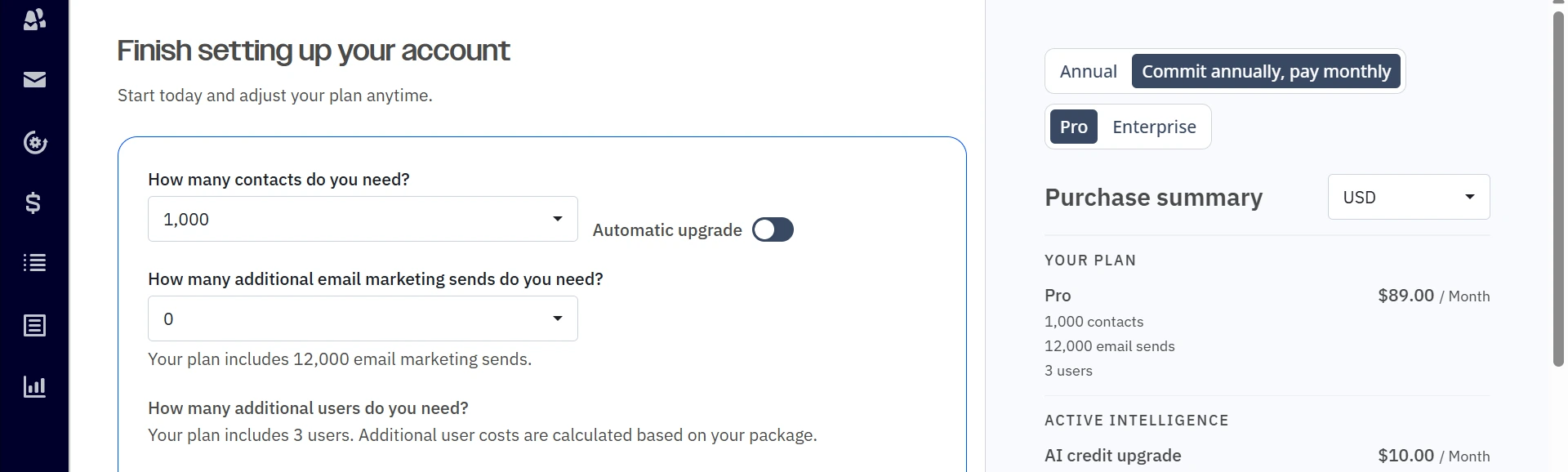
“Commit annually, pay monthly” is not monthly billing. It is still a one-year contract, paid in twelve instalments, and it costs more than paying the year at once: $89 a month for Pro and $159 for Enterprise at 1,000 contacts.
True month-to-month billing does exist, but only for the two lower plans and only if you ask. ActiveCampaign’s support team confirmed it to me in writing: $19 a month for Starter and $59 for Plus at 1,000 contacts. Neither price appears on the pricing page or the billing page. If you want to pay monthly without a yearly commitment, ask support before you buy and keep their answer.
The plan you need depends mainly on how much automation you want to build, and the limits are tighter at the bottom than most buyers expect:
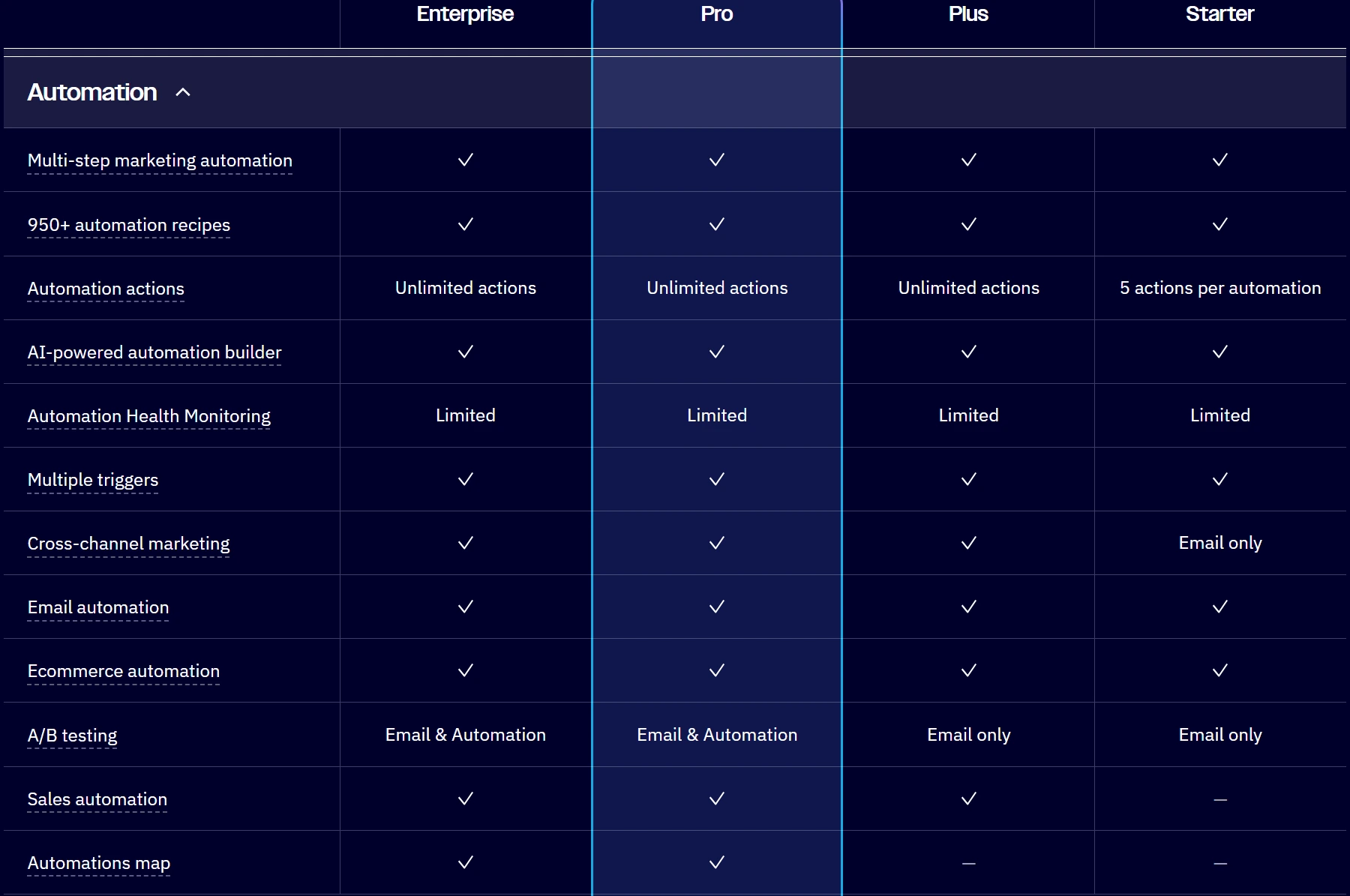
In plain terms:
If you are not sure you need branching automation at all, my guide on how to set up a welcome email series shows what a simple sequence needs, and that kind of sequence fits inside Starter’s five-action limit.
Add-ons are where an ActiveCampaign bill grows, and their prices are not published. I asked ActiveCampaign’s support team, and this is what it gave me in writing in October 2026, as monthly prices:
| Add-on | Starter | Plus | Pro |
|---|---|---|---|
| Extra user | $10 (one extra user only) | $15 | $30 |
| Extra user on an account with the CRM | Not available | $39 | $59 |
| Enhanced CRM (pipelines and sales engagement) | Not available | $85 | $139 |
| Custom reporting | Not available | $159 | $159 |
| Transactional email, 10,000 emails | $15 | $15 | $15 |
| SMS, base package of 1,000 credits | Not available | $21 | $21 |
The CRM is the add-on that changes the picture most. At 1,000 contacts it costs more than the Plus plan itself, and it also raises the price of every extra user. If a sales pipeline is the main reason you are looking, compare ActiveCampaign with a tool built as a CRM first, because you may be paying for automation you don’t need.
WhatsApp is sold as a separate plan or as an email-and-WhatsApp bundle, and on the listed prices the bundle is the cheaper way to get both. The SMS marketing page explains how texting works in the account, and my ActiveCampaign review covers the WhatsApp plans and bundles in detail.
List prices only make sense once you build an actual bill. These three examples use the prices above:
The third bill is more than double the second, for the same list. That is the pattern to plan for: the contact count sets the starting price, but add-ons and seats decide what you actually pay.
Two rules quietly push accounts into a higher tier.
The first is how contacts are counted. According to ActiveCampaign’s help center, on accounts created on or after November 3, 2025, all contacts count toward your limit regardless of their list status, so people who unsubscribed can still take up paid space. When you reach the limit, campaigns stop sending until you upgrade, and automations keep running but skip their email steps. There is an auto-upgrade setting that moves you up a tier instead: it protects your sending, but the higher price starts straight away.
The second is your email allowance. Each plan includes a monthly number of sends tied to your contact limit: ten times on Starter and Plus, twelve on Pro and fifteen on Enterprise. Going over costs $0.005 per extra email, or $5 per thousand. If you know you will need more, the billing page sells 10,000 extra sends for $7 a month, which is far cheaper than the overage rate.
ActiveCampaign has no free plan. It offers a 14-day free trial that needs no card, limited to 100 email sends, which is enough to build your automations and test the editor but not to run a real campaign.
Discounts are limited. Paying yearly is the main saving. Non-profits can ask sales or support for 20% off with proof of status. New customers on annual plans can claim a 30-day money-back guarantee, but only if they cancel and open a support ticket within 30 days, and the help center’s general refund policy says there are no refunds outside it. Treat the first 30 days of a paid plan as the time to decide.
Most of the savings come from how you manage the account, not from a coupon:
2. Start on monthly billing. Pay month to month on Starter or Plus while you test, and switch to yearly only when you are sure. The yearly saving is real, but so is the no-refund rule.
3. Skip Starter above a few thousand contacts. At 10,000 contacts Plus costs only $40 a month more and removes the five-action limit.
4. Decide on auto-upgrade on purpose. Turn it on if a pause in sending would cost you sales; turn it off if you would rather clean your list first.
5. Buy extra sends in advance if you send often, instead of paying the overage rate.
ActiveCampaign is not the cheapest email tool, and it doesn’t try to be. From 2,500 contacts up, its Starter plan costs more than the entry plans of Campaigner and MailerLite, and at every size I checked its Plus plan costs more than the automation plans of all three tools I compared it with. What the extra money buys is deeper automation, a CRM in the same account and more than 1,000 integrations.
My email marketing software price comparison puts all four tools side by side from 1,000 to 10,000 contacts. If you are weighing it against one tool, I have compared MailerLite vs ActiveCampaign and ActiveCampaign vs Mailchimp in detail.
It is worth it when automation is the main job: an online shop with abandoned-cart and post-purchase flows, or a business that wants leads scored and passed to a salesperson. For those uses Plus is the plan to price, and the CRM add-on is worth adding only if you will use the pipeline every day. It is not worth it for a simple newsletter, where cheaper tools do the same job.
If the numbers work for you, you can check the price at your own contact count on ActiveCampaign’s pricing page, or start ActiveCampaign’s 14-day free trial and build one automation before you pay. For everything beyond price, read my full ActiveCampaign review or my guide on how to choose email marketing software.
It starts at $15 a month for 1,000 contacts on Starter, billed yearly. Month-to-month billing costs more and is offered only on Starter and Plus, through support. The price then rises with your contact count, your add-ons and the number of users, as the tables above show.
No. ActiveCampaign has no free plan. It has a 14-day free trial with no card required, limited to 100 email sends.
On accounts created on or after November 3, 2025, yes: all contacts count toward the limit regardless of list status. Archived contacts do not count, so archiving people you no longer email keeps you in a lower tier.
The Enhanced CRM is an add-on, not included in any plan. It is not available on Starter, its price on Plus and Pro is in the add-on table above, and extra users cost more once it is added.
Keep reading
Leads get lost when they are spread across inboxes, phones and memory. Here is how to track sales leads for free in one list,…
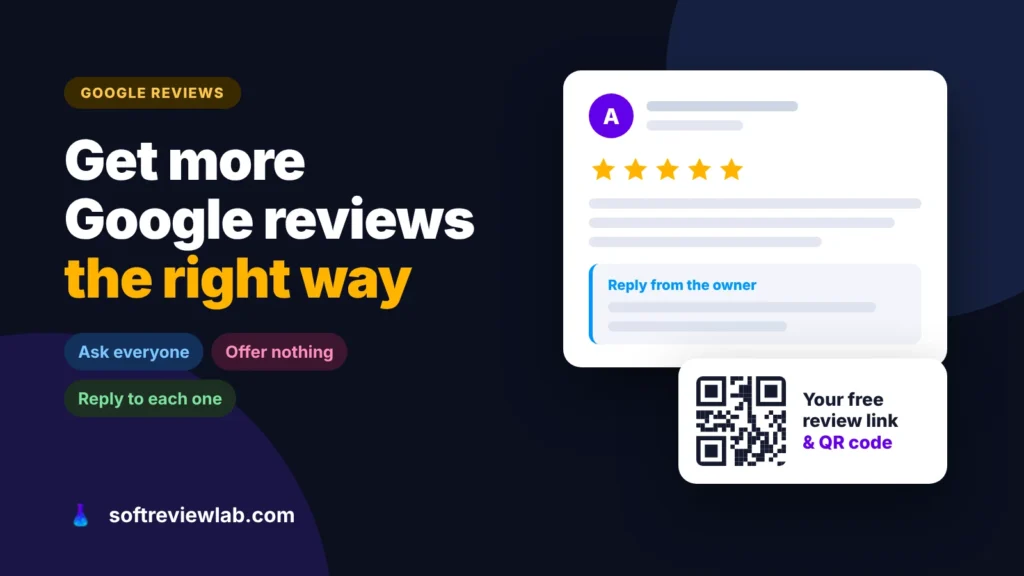
Most happy customers never leave a review because nobody asks and nobody makes it easy. Here is how to get more Google reviews with…
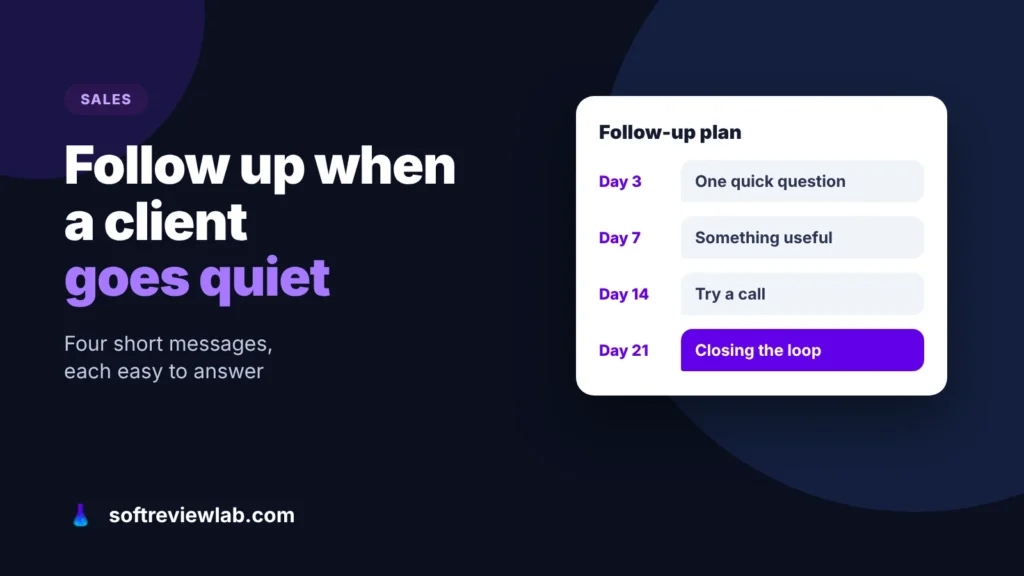
Most clients who go quiet are busy, not saying no. Here is a follow-up sequence that gets replies without annoying anyone, messages you can…