
- Home
- Comparisons
- 9 Critical Campaigner vs Mailchimp Differences Evaluated (2026 Pricing)
9 Critical Campaigner vs Mailchimp Differences Evaluated (2026 Pricing)
Email Marketing Platforms · Different scopes, similar audiences
Table of Contents
Choosing between email marketing solutions requires a close look at how your organization operates. The Campaigner vs Mailchimp discussion often surfaces when businesses outgrow basic newsletter tools and need a scalable data ecosystem. Both platforms are veterans in the digital marketing space, but they have evolved in entirely different structural directions over the past several years. Campaigner doubled down on core email functionality, focusing heavily on complex automation, high-volume sending capabilities, and granular API controls.
Meanwhile, Mailchimp expanded its infrastructure to become a broad, all-in-one marketing suite, incorporating landing pages, social media tools, and a basic CRM to serve as a central hub. In this comprehensive Campaigner vs Mailchimp analysis, we evaluate both platforms using verified data from independent software review sites like G2 and TrustRadius, looking strictly at architecture, usability, and the latest 2026 pricing structures.
Note: External links to official documentation are included throughout if you want to inspect raw developer notes, but this article contains 100% of the complete, unbiased information required to solve your issue and make a confident decision—no additional research needed.
1. Campaigner vs Mailchimp: Updated 2026 Pricing and Cost Structure
Pricing models differ significantly when looking at the Campaigner vs Mailchimp financial requirements. Software expenses are a primary constraint for scaling businesses, and understanding the billing thresholds of each tool is necessary to project long-term operating costs accurately.
Campaigner Cost Analysis
Historically positioned as an enterprise-grade tool, Campaigner has heavily restructured its entry pricing for 2026. According to the current specifications on their official pricing page, Campaigner now offers an entry tier starting at $14 per month for up to 1,000 contacts. This represents a major shift from their legacy $59/month entry point, opening the platform to smaller businesses that still require advanced automation.
For larger lists, Campaigner maintains a volume-based scaling model. A notable structural difference is how Campaigner calculates audience size. Unlike many competitors, Campaigner does not charge users for unsubscribed contacts or bounced email addresses that remain in the database for suppression purposes. You only pay for active, mailable subscribers.
Furthermore, Campaigner offers dedicated multi-client pricing for marketing agencies. This allows an agency to run multiple separate client instances under one master billing account, which scales more efficiently than buying separate retail licenses for every client.
Mailchimp Cost Analysis
Mailchimp offers a highly structured four-tier pricing system: Free, Essentials, Standard, and Premium. According to their 2026 marketing pricing page, Mailchimp’s Free tier is now capped at 250 contacts and 500 monthly sends, which is a significant reduction from previous years. It remains a viable option for brand-new entities or small grassroots organizations that do not yet have a subscriber base.
The paid tiers scale based on both feature access and list volume. The Essentials plan starts at $13 per month for up to 500 contacts. However, most growing businesses will require the Standard plan, which starts at $20 per month for up to 500 contacts and includes a 14-day risk-free trial.
A critical element of Mailchimp’s billing structure is that it charges for all contacts housed in the database. This includes active subscribers, unsubscribed users, and non-subscribed contacts (people who made a purchase but did not opt into marketing). Organizations with strict list hygiene may not notice this, but businesses with high turnover rates or large inactive lists could face inflated monthly software costs if they do not regularly purge unsubscribed data.
Mailchimp’s monthly send limit on the Standard plan is calculated at 12 times your maximum contact count. If you exceed this limit, overage charges automatically apply.
2. Campaigner vs Mailchimp: Core Platform Scope and Architecture
Understanding the fundamental architecture of these tools is the next step in the Campaigner vs Mailchimp evaluation. Software scope dictates how your internal teams will use the platform daily.
The All-in-One Approach
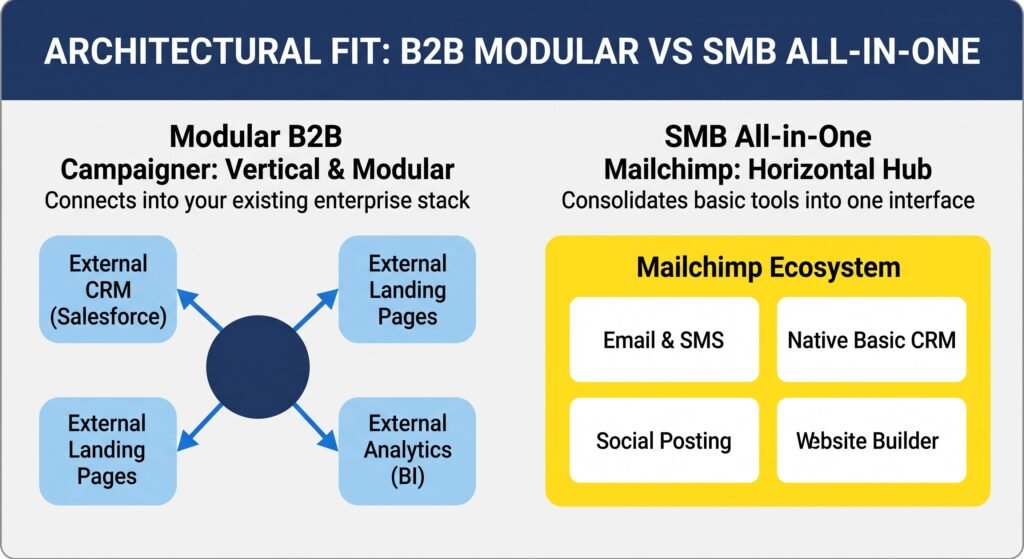
Mailchimp operates as a horizontal, all-in-one marketing ecosystem. Users can log into one dashboard to build landing pages, schedule Facebook and Instagram advertisements, manage social media posting calendars, and utilize a basic customer relationship management (CRM) interface to track user interactions.
This broad scope means lean marketing teams can consolidate their software stack. Instead of paying for a social media scheduler, a landing page builder, and an email tool separately, they can run basic versions of all these functions inside Mailchimp. The trade-off for this horizontal breadth is vertical depth. While Mailchimp does many things, it does not possess the deep, granular complexity in any single category that a dedicated, specialized tool would offer.
The Specialized Approach
Campaigner takes a strictly vertical, specialized approach. It does not attempt to manage your social media calendar, nor does it try to replace your website host or your primary CRM. Instead, it offers deep, specialized features dedicated purely to email and SMS marketing execution.
If your marketing team already utilizes disparate, highly capable tools for different marketing tasks (e.g., you use Salesforce for CRM, Unbounce for landing pages, and Sprout Social for social media), Campaigner fits seamlessly into a modular software architecture. It assumes you already have a tech stack and only need a robust deployment engine for email automation.
For complete, unbiased details—including full pros, cons, hidden limitations, and pricing analysis to help you make the right buying decision—read our Full Campaigner Review Here.
Keep in mind that Campaigner is merely one vetted option for enterprise architecture. If your team’s sending volume is low, you can often bypass dedicated email platforms entirely and utilize the native email engines built into your existing CRM.
3. Campaigner vs Mailchimp: Automation and Logic Workflows
Automation capabilities are the most frequent point of contention in the Campaigner vs Mailchimp debate. Automation reduces manual workload and ensures timely communication with subscribers based on their specific behaviors.
Campaigner Automation Capabilities
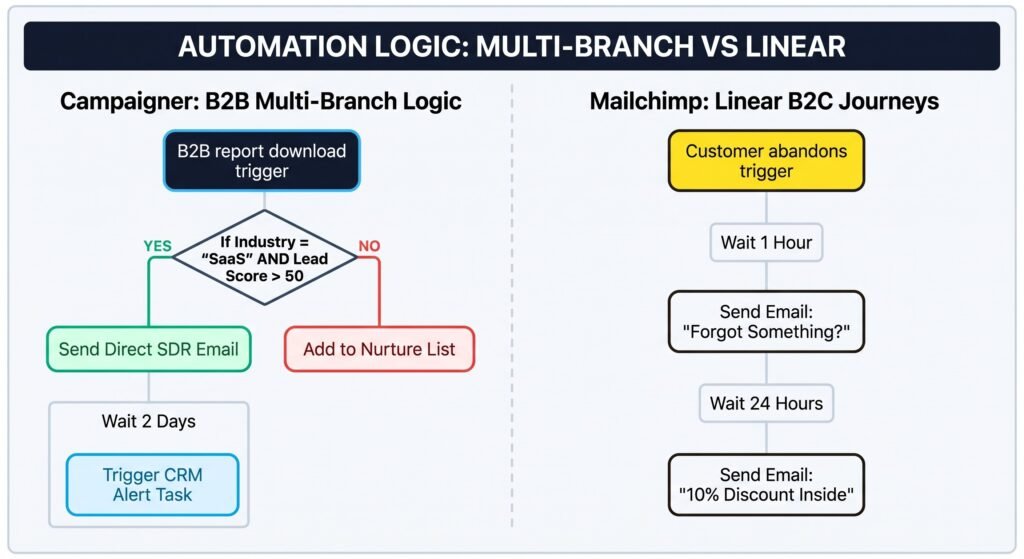
Campaigner provides an advanced visual workflow builder designed for complex, mid-market requirements. The system allows users to build deep branching logic based on multiple concurrent conditions. For example, a workflow can route a user down Path A if they clicked a specific link, opened an email within 48 hours, and have a purchase history exceeding $500. If they fail any of those conditions, they can be routed down Path B.
Reviewers on technical software platforms frequently note that Campaigner excels in its flexibility. Users can utilize dynamic content blocks that alter the rendering of the email based on the recipient’s custom data fields. Furthermore, Campaigner supports integrated SMS automation, allowing you to trigger a text message within the same workflow if an email goes unopened for a specified duration.
Mailchimp Automation Capabilities
Mailchimp utilizes a feature labeled Customer Journeys. This visual builder is highly intuitive, featuring a clean user interface that allows users to set up behavioral triggers quickly. It is highly accessible to users with minimal technical background or coding knowledge.
Mailchimp’s automation handles standard e-commerce triggers effectively. You can easily deploy abandoned cart sequences, welcome series, and post-purchase follow-ups. In 2026, Mailchimp also introduced enhanced automations and generative AI features to assist in building these funnels on the Standard and Premium plans.
However, independent evaluations note that Mailchimp lacks the multi-layered conditional branching sophistication found in Campaigner’s workflow builder. If your automation strategy requires checking against complex historical data sets before sending a message, Mailchimp’s logic paths can become restrictive.
Read our deep dive into advanced email marketing automation strategies here.
4. Campaigner vs Mailchimp: Templates and Email Design Ecosystem
The visual presentation of marketing communications relies heavily on the available editors, the underlying HTML rendering engines, and the pre-built template libraries provided by the software.
Pre-Built Template Libraries
In the Campaigner vs Mailchimp template comparison, volume and variety are key factors. Campaigner offers a massive library of over 900 pre-built, responsive templates. This high volume ensures that users can find a structural starting point for almost any niche industry, seasonal holiday, or specific internal use case (like newsletters, receipts, or event invitations).
Mailchimp provides a smaller library of just over 100 templates on its standard tiers. However, user consensus across design forums often notes that Mailchimp’s baseline designs feel slightly more modern and aesthetically refined out of the box. Mailchimp heavily emphasizes clean typography and generous whitespace in its default layouts.
Editor Functionality
Both platforms provide standard drag-and-drop visual editors that require zero coding knowledge. You can pull text blocks, image placeholders, and button modules directly onto the canvas.
Mailchimp includes additional features within its editor, such as a built-in markdown capability for users who prefer writing formatting syntax directly into text blocks. Mailchimp also offers custom-coded email templates on its Standard plan and above, allowing developers to lock specific sections of an email so junior staff cannot break the branding guidelines.
Campaigner’s editor is stable and heavily focused on dynamic content insertion. While it may lack the immediate aesthetic polish of Mailchimp’s interface, it provides rigorous tools for conditional rendering—meaning you can easily set a specific image block to only appear if the recipient lives in a specific geographic region. Both platforms allow users to upload custom HTML code for complete, raw design control.
5. Campaigner vs Mailchimp: Deliverability Infrastructure
Getting emails successfully delivered into the primary inbox rather than the spam or promotions folder is the foundational metric of email marketing. Deliverability is governed by the platform’s shared IP reputation, authentication protocols, and server infrastructure.
Mailchimp Deliverability
According to user aggregate data and industry deliverability tests, Mailchimp enforces strict compliance rules regarding list imports and spam complaints, their shared IP pools remain highly reputable among major inbox providers like Gmail, Yahoo, and Outlook.
For small businesses sending standard newsletters, Mailchimp provides an incredibly stable infrastructure that requires almost no manual technical configuration regarding server reputation.
Campaigner Deliverability
Campaigner is heavily utilized by high-volume senders, which requires a different approach to deliverability. While their shared IP pools are closely monitored, Campaigner shines in its custom deliverability configurations.
Organizations sending hundreds of thousands of emails monthly can configure Campaigner with dedicated IP addresses. Campaigner provides detailed server logs, allowing technical marketing teams to diagnose exactly why an email bounced at the server level. Furthermore, Campaigner supports strict DMARC, DKIM, and SPF authentication protocols. Their deliverability management tools score highly among enterprise users who require absolute control over their sender reputation.
6. Campaigner vs Mailchimp: CRM and Third-Party Integrations
Modern marketing relies on seamless data synchronization across multiple platforms. A standalone email tool is useless if it cannot read the data generated by your website or sales software.
Integration Ecosystems
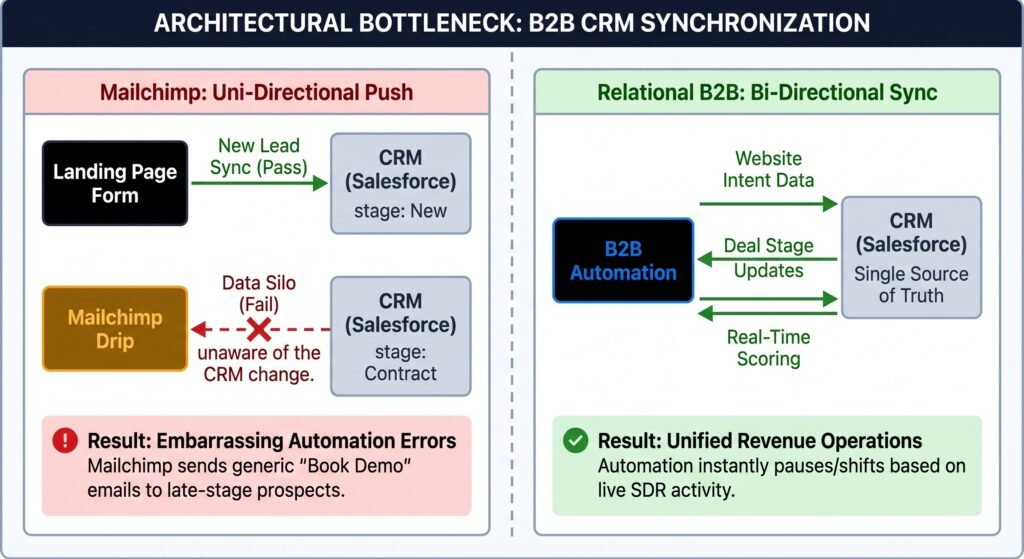
Mailchimp consistently scores higher in verified user reviews regarding immediate, plug-and-play integration capabilities. On platforms like G2, Mailchimp outpaces Campaigner in CRM integration satisfaction and Social Media connection reliability. Mailchimp seamlessly connects with major global platforms like Shopify, WooCommerce, WordPress, and Salesforce. Because of Mailchimp’s massive market share, almost every SaaS product in the world builds a native Mailchimp integration by default.
Campaigner provides a highly robust REST API and integrates natively with numerous enterprise-level third-party services. However, it relies more heavily on external connectors (like Zapier or Make) for some of the smaller e-commerce or niche platform functions compared to Mailchimp’s native library.
Native CRM Functionality
As mentioned in the architecture section, Mailchimp includes a native, lightweight CRM. You can track customer lifetime value, segment users based on purchase history, and view individual contact profiles showing every interaction they have had with your brand.
Campaigner does not include a native CRM. It operates purely as an execution engine. It expects you to manage your customer data in a dedicated CRM (like HubSpot or Salesforce) and push the necessary execution data into Campaigner via API or native sync.
7. Campaigner vs Mailchimp: Analytics, Testing, and Reporting
Evaluating campaign success requires accurate data analysis. Without reporting, marketing teams cannot optimize their future sends.
Split Testing Capabilities
A/B testing is where the Campaigner vs Mailchimp comparison highlights different target audiences. Mailchimp offers basic A/B testing on its Essentials plan, allowing users to test different subject lines, sender names, or send times. If you want Multivariate testing (testing up to eight different variables simultaneously), you must upgrade to Mailchimp’s Standard or Premium plans.
Campaigner provides granular data, particularly for split testing. Advanced multivariate testing is a core feature for Campaigner users, allowing for simultaneous testing of multiple subject lines, content variations, and dynamic block logic. Users transitioning to Campaigner often cite its rigorous testing data as a primary reason for the switch, as it allows statistical significance to be reached faster on high-volume sends.
Dashboard and Reporting
Mailchimp provides a highly visual, intuitive reporting dashboard that clearly displays open rates, click-through rates, audience growth trends, and e-commerce revenue attribution. The reports are easy to export and present directly to stakeholders.
Campaigner’s reporting interface presents a steeper learning curve. The depth of the data appeals to data analysts who require detailed performance metrics, heat maps, and device-specific rendering reports, but it may feel overwhelming to a novice user looking for a simple bar chart of their open rates.
8. Campaigner vs Mailchimp: E-commerce Functionality
For retail businesses, the ability to directly tie email marketing to product sales is critical. Both platforms offer specific tools for online merchants.
Mailchimp is deeply intertwined with the e-commerce sector. With its native Shopify and WooCommerce integrations, Mailchimp can pull product catalogs directly into the email editor. You can drag a product block into an email, and Mailchimp will automatically populate the image, price, and link based on your store’s database. Furthermore, Mailchimp’s predictive segmentation (available on higher tiers) can estimate the future buying behavior of customers, allowing you to target users who are mathematically likely to purchase again.
Campaigner also supports e-commerce functionality, particularly with its advanced purchase behavior segmentation. You can build segments based on lifetime spend, average order value, or specific SKUs purchased. While it may require slightly more initial configuration to map the data fields from your store to Campaigner, the resulting automation logic can be more complex than what is possible in Mailchimp’s standard journeys.
9. Campaigner vs Mailchimp: Agency and Multi-Account Management
For marketing agencies managing communications for multiple distinct clients, the software requirements change drastically.
Campaigner offers purpose-built multi-client architecture. An agency can log into a single master console and manage dozens of sub-accounts. Billing is consolidated, and agencies can share customized templates across all sub-accounts to maintain brand consistency. The pricing scales based on aggregate volume, making it highly cost-effective for large agency rosters.
Mailchimp does not offer a true multi-client console in the same manner. Agencies using Mailchimp typically have to log in and out of separate client accounts, or use Mailchimp & Co (their partner program) to gain access to client-owned accounts. Billing remains tied to the individual client’s subscriber count, which can become expensive and difficult to manage at scale.
Campaigner vs Mailchimp: HTML Comparison Table
This table outlines the objective feature differences between the two platforms based on available 2026 data.
Campaigner vs Mailchimp: Original Pros and Cons
Based on verified independent evaluations and technical platform specifications, here are the respective pros and cons. These bullet points match the included JSON-LD structured data markup exactly.
Campaigner Pros
- Entry pricing now starts at a highly accessible $14 per month for 1,000 contacts.
- Does not bill user accounts for unsubscribed or suppressed contacts.
- Provides a massive library of over 900 pre-built responsive email templates.
- Features highly flexible, advanced behavioral automation with true branching logic.
- Includes dedicated multi-client dashboard capabilities for marketing agencies.
Campaigner Cons
- The data reporting interface presents a steeper learning curve for novice users.
- Lacks native social media scheduling and broad marketing suite tools.
- Does not offer a permanent free tier for testing purposes.
Mailchimp Pros
- Features an intuitive, highly user-friendly drag-and-drop workflow interface.
- Includes a comprehensive suite of marketing tools including a native CRM and landing pages.
- Offers an extensive library of native third-party plug-and-play integrations.
- Provides a free entry-level tier for very small lists up to 250 contacts.
- Delivers actionable insights into audience growth and e-commerce conversion funnels.
Mailchimp Cons
- Bills user accounts for all database contacts including those who have unsubscribed.
- Automation branching features are less sophisticated for highly complex enterprise routing.
- The free plan limits have been drastically reduced to only 500 monthly sends.
Campaigner vs Mailchimp FAQ
Which platform is more cost-effective for growing lists in 2026?
The cost-effectiveness in the Campaigner vs Mailchimp comparison depends heavily on your database hygiene. Campaigner’s entry pricing starts at $14/month for 1,000 contacts and strictly does not charge for unsubscribes. Mailchimp’s Standard plan starts at $20/month for 500 contacts and bills for all contacts housed on the list, including those who have opted out.
Does Campaigner offer a free plan?
No, Campaigner does not offer a permanent free plan. Their current pricing begins at $14/month for the entry tier, bypassing the freemium model entirely to focus on paid support and deliverability.
Can I manage social media ads with these tools?
Mailchimp allows users to manage, build, and schedule social media posts and digital advertisements directly from its centralized dashboard. Campaigner is strictly focused on vertical email and SMS marketing and does not support external social media management.
Which tool is better for e-commerce integrations?
According to aggregate user reviews, Mailchimp scores higher for out-of-the-box e-commerce integrations, offering seamless, native connections to platforms like Shopify and WooCommerce that pull product data directly into the editor.
Do both platforms support HTML custom templates?
Yes, both Campaigner and Mailchimp allow technical users and developers to design emails using custom HTML code, which operates alongside their standard drag-and-drop visual editors.
See every matchup
Browse the rest of the head-to-head comparisons, or jump straight to the full reviews.