
- Home
- Buyer’s guides
- B2B Email Marketing Automation: 3 Critical Rules to Stop Pipeline Leaks
B2B Email Marketing Automation: 3 Critical Rules to Stop Pipeline Leaks

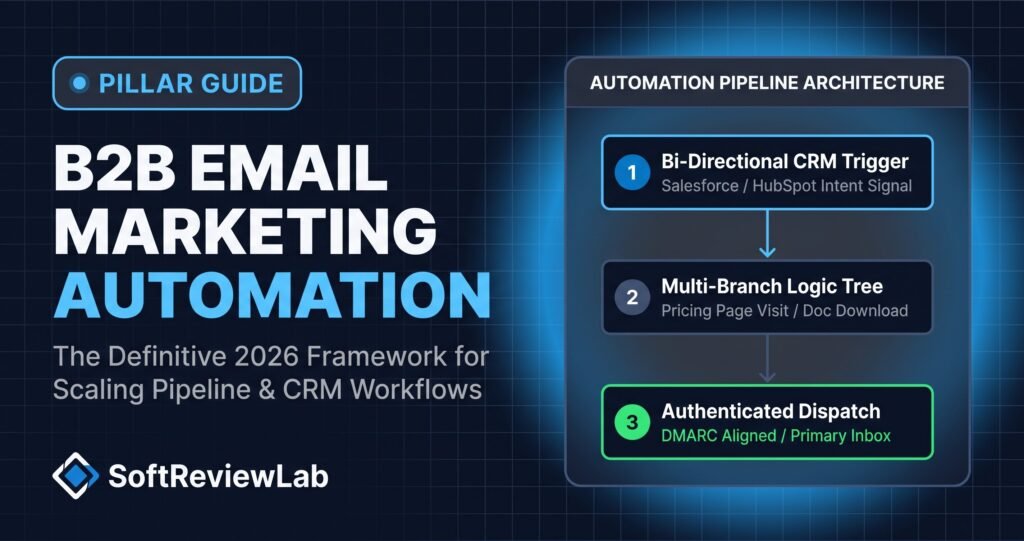
Table of Contents
Enterprise B2B organizations achieve scalable revenue growth by implementing sophisticated b2b email marketing automation strategies that integrate CRM data, trigger behavior-based nurturing sequences, and enforce rigorous technical deliverability protocols. When marketing and sales operations teams rely on manual outreach or disparate, unauthenticated systems, they suffer from stalled pipelines, disconnected buyer journeys, and catastrophic domain reputation damage routing high-value communications directly into corporate spam folders.
Modern B2B buyers demand highly personalized, context-aware interactions. If your email engine cannot dynamically serve the right content based on a prospect’s intent signals—such as visiting a pricing page, downloading technical documentation, or engaging with sales collateral—your messages will be ignored as generic noise.
Resolving these operational bottlenecks requires a fundamental shift from broadcast email blasts to automated, lifecycle-based communication frameworks. This transformation does not inherently demand an enterprise-grade software contract on day one. Marketing operations teams can audit and optimize their foundational technical infrastructure for free:
- Enforce Strict DNS Authentication Manually: Before paying for expensive platforms, use free terminal commands (
dig txt yourdomain.com) or web tools like MXToolbox to validate SPF, DKIM (2048-bit keys), and DMARC alignment policies. - Execute Aggressive Database Hygiene: Purge any contact that has not opened or clicked an email in 120 days. Keeping dormant data destroys your sender score.
- Map CRM Data Points: Before automation, ensure your core B2B data points (Company Size, Lead Source, Job Title, Deal Stage) are flowing cleanly from your CRM into your email client for precise segmentation.
Only when your organization requires advanced visual workflow builders, multi-branch conditional logic trees, and robust API integrations to sync marketing triggers with SDR outreach should you evaluate dedicated automation platforms. For a detailed, objective audit of how one specific vendor handles these core requirements against pricing paywalls, see our unvarnished audit of feature gates and pricing tiers within our detailed tool teardown.
Note: External links to official cryptographic standards and vendor documentation are included throughout if you want to inspect raw developer notes, but this article contains 100% of the complete, unbiased information required to solve your operational challenges and make a confident decision—no additional research needed.
The Strategic Pillar of B2B Revenue Growth
B2B email marketing automation is no longer a “nice-to-have” tactic; it is the central nervous system connecting modern marketing demand generation efforts with outbound sales development teams. It bridges the gap between anonymous website traffic and qualified pipeline.
If your B2B firm is struggling with low lead-to-opportunity conversion rates, stagnant pipeline velocity, or sales teams complaining about unqualified inbound leads, the root cause is almost always a failure to automate relevant, timely communication based on buyer behavior.
Beyond Newsletters: The Lifecycle Approach
Effective B2B automation shifts the focus from periodic newsletters to automated lifecycle campaigns that guide a prospect from awareness to advocacy:
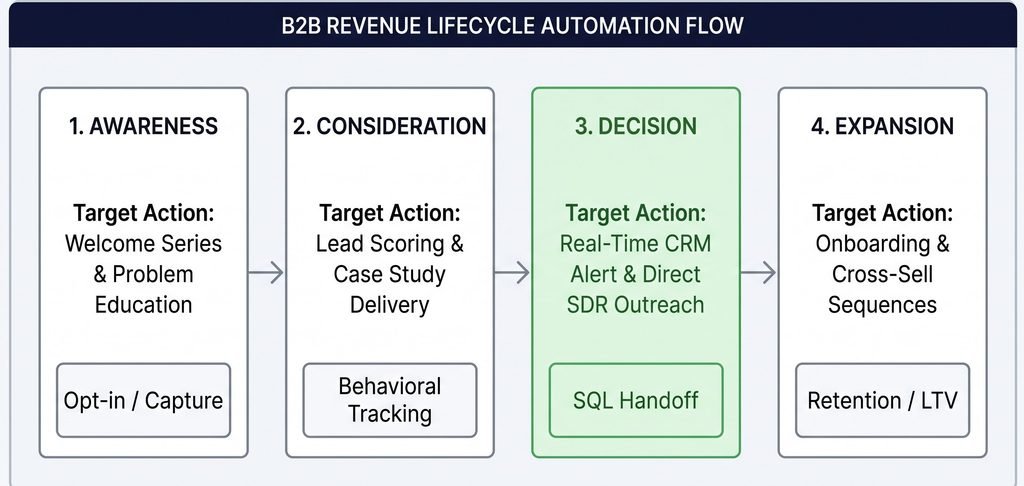
- Awareness Stage: Automated welcome series that educate new subscribers about industry problems and your unique solution methodology.
- Consideration Stage: Lead scoring and nurturing workflows that deliver case studies, webinars, and ROI calculators based on specific content consumption.
- Decision Stage: Real-time alerts sent to CRM owners when high-intent prospects exhibit buying signals, allowing for immediate, personalized SDR outreach.
- Expansion Stage: Post-sale onboarding and cross-sell sequences that drive customer retention and lifetime value.
Connecting these disparate stages requires a unified automation architecture that acts as a single source of truth for buyer intent.
Core Components of a World-Class B2B Automation Stack
Before selecting a platform, you must ensure your internal operational house is in order. A sophisticated automation platform cannot fix broken data or unaligned sales and marketing processes.
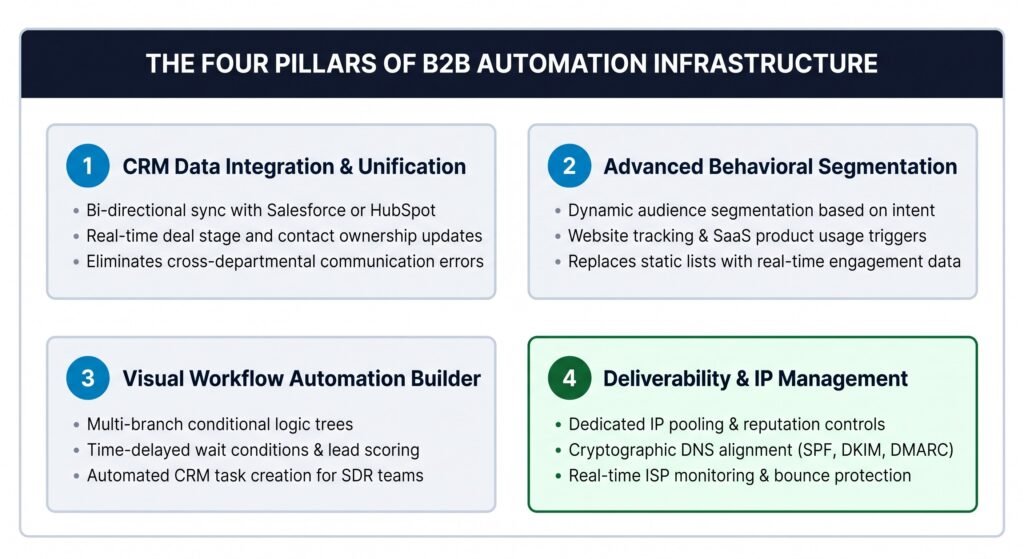
1. CRM Data Integration & Unification
The lifeblood of B2B automation is clean, accessible data. Your email platform must bi-directionally sync with your central CRM (e.g., Salesforce, HubSpot, Microsoft Dynamics). Without real-time data synchronization, you cannot personalize outreach based on deal stage, contact owner, or recent sales activity.
Automation without integration leads to embarrassing scenarios, such as marketing sending a “Book a Demo” email to an existing customer who is currently in late-stage contract negotiations with your sales team.
2. Advanced Behavioral Segmentation
Modern B2B buyers leave a digital footprint. Your automation platform must capture behavioral data—not just demographic data—to power dynamic segmentation.
Effective B2B platforms allow you to segment audiences based on:
- Email Engagement: Opens, clicks, and specific content interactions.
- Website Activity: Pages visited, content downloaded, and frequency of return visits.
- Product Usage (SaaS): Feature adoption rates, trial progression, and login frequency.
- Content Consumption: Viewing webinars, reading specific solution pages, or interacting with ROI tools.
Static lists are obsolete. Dynamic segmentation ensures that the right message is delivered to the right prospect at the precise moment of relevance.
3. Visual Workflow Automation Builder
The days of linear, “if this, then that” autoresponder series are gone. Enterprise B2B buying committees are complex, often involving 6 to 10 decision-makers.
Your automation engine must utilize an intuitive drag-and-drop visual builder that supports complex, multi-branch logic trees. These workflows should allow for:
- Wait Conditions: Delaying actions based on specific time intervals or behavioral triggers.
- Branching Logic: Splitting paths based on demographic data (e.g., Enterprise vs. SMB) or behavioral intent (e.g., engaged vs. disengaged).
- Lead Scoring Updates: Incrementally increasing or decreasing lead scores based on engagement, ensuring Sales only pursues sales-qualified leads (SQLs).
- Sales Task Creation: Automatically creating tasks or alerts within the CRM for SDRs to initiate direct outreach.
4. Deliverability Infrastructure & IP Management
All the automation logic in the world is useless if your emails land in the junk folder. B2B email deliverability is an engineering discipline, not a marketing afterthought.
Your platform must provide robust deliverability tools, including:
- Dedicated IP Addresses: For high-volume senders who need full control over their sending reputation (separate from shared pools).
- Authentication Support: Full native support for SPF, DKIM (2048-bit keys), and DMARC policy alignment. For a deep dive into securing your infrastructure, read our official cryptographic standards and vendor documentation.
- Deliverability Monitoring: Tools to track inbox placement rates, ISP reputation scores, and blocklist monitoring.
For critical guidance on ensuring your technical setup prevents domain blacklisting, review our comprehensive Google Bulk Email Sender Guidelines
.
Phase 1: The Technical Foundation (Do This Before Buying Software)
You cannot solve deliverability problems with more software. Before investing in an automation platform, you must secure your technical domain infrastructure. This manual audit fixes the majority of inbox placement issues.
Manual DNS Authentication Setup (SPF, DKIM, DMARC)
Authentication signals to mailbox providers (like Google Workspace and Microsoft 365, which power most B2B inboxes) that you are who you say you are and that your domain is not being spoofed by malicious actors.
- Sender Policy Framework (SPF): This is a DNS TXT record that lists all the IP addresses and services authorized to send email on your behalf. Misconfiguration here (specifically exceeding the 10 DNS lookup limit) causes immediate authentication failures.
- DomainKeys Identified Mail (DKIM): This adds a cryptographic signature to your email headers, allowing receiving servers to verify that the message was not altered in transit. We strongly recommend utilizing modern 2048-bit keys.
- Domain-based Message Authentication, Reporting, and Conformance (DMARC): This protocol ties SPF and DKIM together, telling receiving servers what to do if an email fails authentication (e.g.,
p=nonefor monitoring,p=quarantineto send to spam, orp=rejectto block entirely).
Crucial First Step: Validate your existing DNS records using free tools like MXToolbox or by running terminal commands (dig txt yourdomain.com). If your records are missing or misaligned, no automation platform on earth can save your deliverability.
Aggressive List Hygiene and Data Management
Purchased lists and unverified contact data are the fastest ways to destroy your sender reputation. B2B data decays rapidly (up to 30% annually due to job changes).
Before importing any data into an automation platform:
- Scrub Role-Based Emails: Immediately remove addresses like
info@,sales@,support@, orcontact@. These are rarely assigned to specific decision-makers and are notorious for containing spam traps. - Verify Email Syntax and MX Records: Use an email validation service to confirm that every address on your list has a valid format and an active Mail Exchange (MX) record capable of receiving mail.
- Implement Sunset Policies: Enforce a strict 90-to-120-day re-engagement policy. If a subscriber has not opened or clicked an email in that timeframe, suppress them automatically. Sending to disengaged recipients signals low value to mailbox providers.
Clean data is not just a deliverability requirement; it is an efficiency requirement that ensures you are not paying to market to dead ends.
CRM Integration Strategy and Data Mapping
Automation fails when marketing and sales data are siloed. Before connecting an automation platform, meet with Sales leadership to align on definitions:
- What is a Marketing Qualified Lead (MQL)? Define the specific demographic and behavioral thresholds that elevate a lead to MQL status.
- What is a Sales Qualified Lead (SQL)? Define the point at which sales accepts ownership and initiates direct outreach.
- What data needs to sync bi-directionally? Ensure critical fields (Campaign Source, Lead Status, Last Activity Date, Persona, Company Revenue) map correctly between the systems.
A successful automation implementation requires unified data governance across the entire revenue funnel.
Phase 2: Selecting and Scaling Your B2B Automation Platform
Once your technical foundation is secure and your data is clean, you can evaluate automation platforms based on your specific business requirements. This is not about finding the “best” platform, but the best platform for your current stage and operational maturity.
Evaluation Criteria for Enterprise & Mid-Market
When assessing potential vendors, move beyond marketing hype and evaluate based on technical infrastructure and strategic fit:
| Evaluation Area | Critical Requirement for B2B |
| Deliverability | Native support for 2048-bit DKIM, DMARC alignment, and flexible IP pooling options. Transparent deliverability consulting and monitoring tools. |
| Integration | Deep, native integration with your specific CRM (Salesforce, HubSpot, etc.). Robust API and webhook capabilities for custom data flows. |
| Scalability | Tiered pricing models that scale predictably with contact volume without gating core automation features behind enterprise paywalls. |
| Automation UX | An intuitive, powerful visual workflow builder capable of handling complex, multi-channel, multi-branch conditional logic. |
| Reporting | Advanced attribution modeling that connects email engagement directly to pipeline generation and closed-won revenue, not just vanity opens and clicks. |
| Compliance | Full, automated support for global privacy regulations (GDPR, CASL, CCPA) with built-in consent management and preference centers. |
The Importance of Pricing Transparency and Feature Gates
Be extremely cautious of “bait-and-switch” pricing models common in the B2B marketing automation space. Many vendors attract buyers with low entry-level pricing but severely gate essential B2B features—such as behavioral segmentation, advanced workflow logic, or API access—into significantly more expensive “Pro” or “Enterprise” tiers.
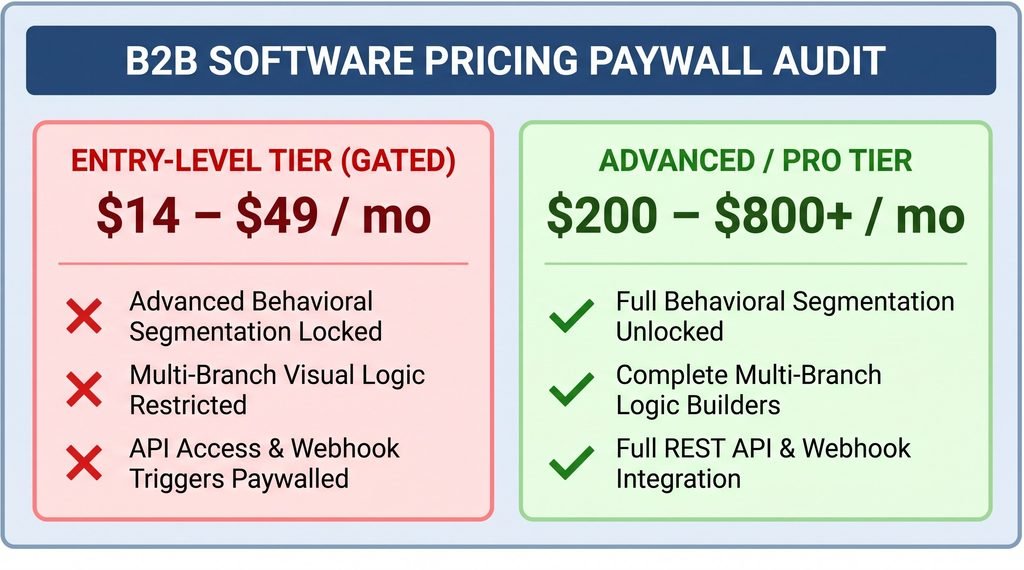
For complete, unbiased details—including full pros, cons, hidden limitations, and pricing analysis to help you make the right buying decision—read our Full Campaigner Review Here.
Keep in mind that Campaigner is merely one vetted option in the enterprise automation landscape. If your organization already operates within an integrated ecosystem like HubSpot, or if you can resolve your workflow bottlenecks using alternative setups, you may not need an all-in-one commercial platform like Campaigner. Empower your technical leads to audit solutions against your specific workflow requirements before committing your budget.
Before committing, require a full audit of all platform fees. contact tier step-ups, and feature restrictions to ensure your total cost of ownership matches your operational budget. Avoid selecting tools that force premature upgrades simply because you need basic conditional logic or native webhook integrations.
Ultimately, mastering b2b email marketing automation is an ongoing operational commitment rather than a static setup. By securing your technical DNS architecture, keeping your CRM data pristine, and deploying intelligent multi-branch workflows, your organization can transform outbound marketing from an unpredictable cost center into a predictable, scalable revenue engine.
Frequently Asked Questions (FAQ)
What is the difference between basic email marketing and B2B email marketing automation?
Basic email marketing typically relies on manual, broadcast-style newsletter blasts sent to static subscriber lists with minimal segmentation. B2B email marketing automation uses dynamic behavioral tracking, multi-branch conditional logic trees, and bi-directional CRM integration to trigger personalized communication sequences automatically based on real-time prospect actions, deal stages, and buying signals.
How does CRM integration impact B2B email automation performance?
Bi-directional CRM integration acts as the operational anchor for B2B automation. Without real-time data sync, marketing automation platforms operate in silos, risking embarrassing messaging errors (such as marketing emails sent to prospects in active sales negotiations). Deep integration ensures lead scores, custom fields, and contact ownership update instantly across both sales and marketing teams.
What is the ideal sending volume for a dedicated IP address in B2B automation?
Dedicated IP addresses are generally recommended only for organizations maintaining high, consistent sending volumes—typically exceeding 50,000 to 100,000 marketing and sales emails per month. Lower-volume senders should rely on reputable shared IP pools maintained by their ESP, because dedicated IPs require continuous, stable volume daily to build and maintain a positive sender reputation with mailbox providers.
How do I prevent automated B2B marketing emails from landing in the spam folder?
Preventing spam placement requires a three-pillar technical approach: first, enforce strict cryptographic domain authentication (valid SPF records, 2048-bit DKIM keys, and aligned DMARC policies); second, maintain rigorous contact list hygiene by purging role-based accounts and unengaged subscribers; and third, warm up new domains or IPs gradually to establish trust with corporate inbox filters like Google Workspace and Microsoft 365.
How this guide was put together. Built from vendor documentation and pricing pages, and from recurring themes in public customer reviews — not from a hands-on lab test. Prices move; confirm on the vendor’s own page before you buy. How we work.
Keep going
More buyer’s guides