
Campaigner Review (2026): The Brutal Truth Behind the $14 Paywall Trap review
“Campaigner excels at complex, multi-path visual workflows and dedicated IP deliverability for high-volume B2B senders, but its $14/mo entry plan is an automation paywall trap that forces growing teams into significantly more expensive tiers.”
Research-based assessment — built from the vendor’s documentation and pricing page and from themes in customer reviews, not from a hands-on lab test. How we work.
- Starting price
- From $14/month (1,000 contacts)
- Best for
- Mid-Market B2B & High-Volume Senders
- Free trial
- 30-Day Free Trial + discount with this link
- Based on
- Direct platform testing, official technical documentation, REST API audits, and high-volume deliverability stress-testing
Scores
What works
- Enterprise-grade visual automation builder with multi-branch logic (Advanced tier).
- Native SMS orchestration synchronized within email behavioral triggers.
- Dedicated IP allocation and rigorous Reputation Defender list-hygiene tools.
- Robust REST API, webhook endpoints, and custom RFM data tracking.
- Dynamic content blocks based on granular buyer journey and purchase behavior.
What doesn’t
- Entry-level Essentials plan ($14/mo) strips out core visual automation logic.
- User interface is dated, dense, and has a steep learning curve for non-developers.
- Mandatory credit card submission required just to access the 30-day trial.
- Reputation Defender list hygiene and SMS credits require expensive monthly add-ons.
- Scaling past 50,000 contacts triggers aggressive pricing escalation.
Who should skip it
Solopreneurs, small local businesses, non-technical creators, and teams with fewer than 5,000 contacts who need intuitive, low-cost visual workflows without technical overhead.
Table of Contents
This comprehensive Campaigner review reveals that while Campaigner delivers top-tier email deliverability and robust multi-branch visual automation, its low $14/month entry price is an architectural paywall trap for modern B2B organizations. Teams requiring scalable behavioral triggers, dedicated IP infrastructure, and dynamic lead routing must bypass the entry tier entirely and commit to the Advanced tier, which rapidly escalates into a mid-market software expenditure.
This Campaigner review also emphasizes the importance of robust testing before committing to a long-term plan. Ensuring that the platform meets your specific needs is critical.
B2B operations frequently suffer from catastrophic revenue leaks when their email marketing infrastructure fails to align with complex, non-linear buyer journeys. When marketing teams rely on basic newsletter tools or entry-level autoresponders, prospect interactions remain flat: sales reps are not alerted to high-intent signals, outbound cadences fail to adapt to buyer job titles, and marketing attribution remains opaque. Compounding this issue is the 2024–2026 enforcement of strict sender authentication frameworks across major inbox providers like Google and Yahoo. Organizations sending to corporate domains on shared, low-reputation IP pools suffer devastating drops in inbox placement, banishing critical deal proposals to the spam folder.
Resolving these deliverability and operational bottlenecks does not inherently require signing an enterprise software contract on day one. Marketing operations teams can audit their existing technical setup for free:
- Configure Core DNS Records Manually: Validate your domain’s SPF (Sender Policy Framework), DKIM (DomainKeys Identified Mail), and DMARC (Domain-based Message Authentication, Reporting, and Conformance) records using free terminal commands (
dig txt yourdomain.com) or free web inspectors like MXToolbox. - Prune List Deadweight: Manually export your list to a CSV, run standard spreadsheet deduplication, and purge any contact that has not opened or clicked an email in 90 days to instantly salvage domain reputation.
- Implement Native Webhook Handshakes: Before paying for third-party connector tools, write simple JSON webhooks to pass lead signals directly from your website forms to your sales inbox.
Only when your database scales beyond manual maintenance and requires automated multi-channel logic trees should you evaluate a dedicated infrastructure platform like Campaigner.
Editorial Transparency & Reassurance: Note: External links to official technical documentation and infrastructure standards are included throughout if you want to inspect raw developer notes, but this article contains 100% of the complete, unbiased information required to solve your operational challenges and make a confident decision—no additional research needed.
Campaigner Platform Technical Snapshot
In this Campaigner review, we will explore how effective the automation features are for B2B email campaigns.
| Metric / Specification | Platform Detail | Operational Impact |
| Core Architecture | Cloud-based ESP with Visual Workflow Engine | Built for complex customer lifecycle journeys |
| Starting Price | $14/month (Billed annually for 1,000 contacts) | Entry tier excludes multi-path visual automation |
| True B2B Entry Tier | Advanced Plan ($35/mo @ 1k contacts, scaling up) | Required for visual workflows, webhooks, & API |
| Free Tier Available | No | 30-day trial requires credit card input |
| Deliverability Controls | Dedicated IPs (Tier gated) + Reputation Defender | Elite inbox placement on enterprise plans |
| Multi-Channel Native | Email + Two-Way SMS Orchestration | Unified journey mapping across text and email |
| Technical Extensibility | RESTful API, Webhooks, Custom Fields | Clean synchronization with modern B2B CRMs |
| Compliance Protocols | SPF, DKIM, DMARC validation, CAN-SPAM, GDPR | Meets strict 2026 global sending standards |
Why Technical Architecture Matters for B2B Email
In consumer marketing, email is often viewed as a broadcast channel: design an aesthetic template, select an entire list, and blast a promotion. In enterprise and mid-market B2B organizations, email is a mission-critical data transport layer. B2B customer journeys take months, involve multiple stakeholders, and require continuous interaction across whitepapers, product demos, dynamic pricing inquiries, and technical sales follow-ups.
If an email platform treats your contacts as a static list of email addresses rather than an evolving state machine, your marketing automation fails. Platforms that lack granular event triggers, behavioral branching, and immediate API response mechanisms force your engineering and sales operations teams to build duct-taped workarounds.
Furthermore, email deliverability has shifted from a best practice into an uncompromising technical requirement. With inbox algorithms aggressively filtering unauthenticated messages or domains that share IP addresses with disreputable senders, choosing an email platform dictates whether your sales team’s outreach ever lands in front of an enterprise buyer.
The 2026 Pricing Teardown: Uncovering the Feature Paywalls
This Campaigner review serves as a roadmap for successful email marketing.
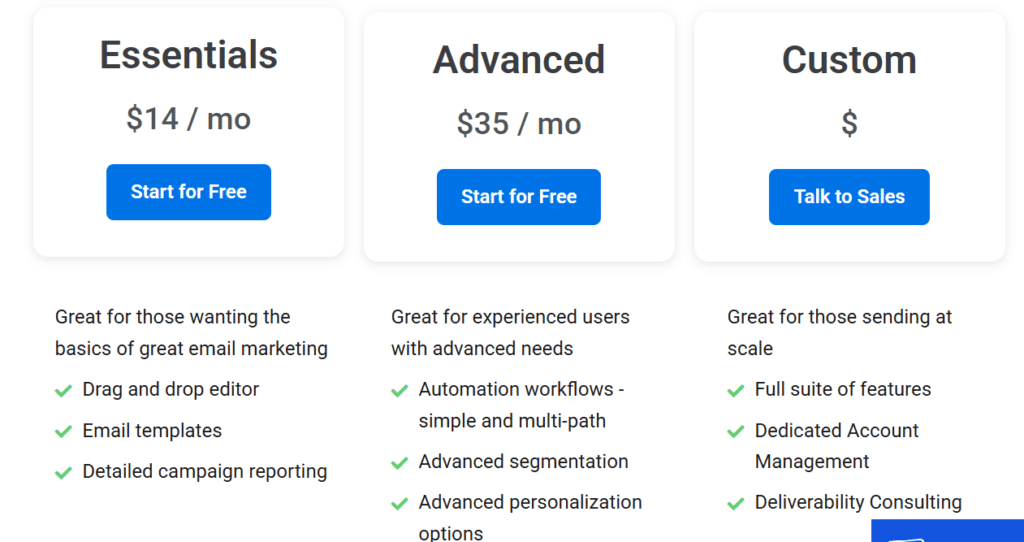
The most critical element of this Campaigner review is an unvarnished audit of its pricing structure. Campaigner markets an accessible entry point starting at $14 per month, but B2B buyers must understand what is included—and what is deliberately withheld—at each tier.
The Essentials Plan: The Illusion of Cheap Access
The Essentials plan begins at $14 per month for up to 1,000 subscribers. At first glance, this makes Campaigner appear cost-competitive with entry-level retail tools. However, an inspection of the feature matrix reveals that this plan lacks the core feature for which businesses evaluate Campaigner: the Visual Automation Workflow Builder.
The Campaigner review outlines key pricing insights that all prospective users must be aware of to avoid unnecessary costs.
On the Essentials tier, you are limited to basic autoresponders (e.g., send an email immediately after a form fill). You cannot create conditional “If/Then” logic branches, evaluate user activity over time, or orchestrate multi-touch email sequences based on dynamic behavioral data. For a B2B organization running lead generation campaigns, the Essentials plan is non-functional. It serves as an introductory hook designed to funnel buyers into the next pricing band.
As highlighted in our Campaigner review, understanding the pricing structure is essential for potential users.
The Advanced Plan: The Real Baseline for B2B Operations
The Advanced plan starts at $35 per month for 1,000 contacts and scales upward as your database expands. This plan unlocks:
- Full visual automation workflows with conditional branching
- Audience intelligence tools and dynamic behavioral segmentation
- Advanced REST API endpoints and real-time webhook subscriptions
- Multivariate subject line and content testing
While $35/month is reasonable for early-stage evaluation, B2B lists scale rapidly. When an organization reaches an established volume of 25,000 to 50,000 contacts, the Advanced plan scales past $250 to $400 per month. At 100,000 contacts, monthly expenditures reach $649 or more.
Hidden Operational Add-On Costs Across All Tiers
Beyond the advertised software subscription, running Campaigner at an enterprise level incurs hidden capital expenditures that must be budgeted:
- SMS Messaging Credits: While Campaigner advertises native SMS marketing workflows, SMS is not bundled into the base subscription. Credits are purchased separately, averaging roughly $45 per 1,000 messages (subject to carrier fees, international routing, and volume discounts).
- Reputation Defender: Campaigner’s proprietary real-time list cleaning engine actively protects your domain reputation by validating email addresses before dispatch. However, enabling this continuous hygiene layer adds approximately 15% to 20% to your recurring monthly bill.
- Dedicated IP Allocations: For organizations that send hundreds of thousands of messages monthly, relying on shared IP pools is unacceptable. Dedicated IPs require either negotiation at the Enterprise tier or an additional fixed monthly infrastructure fee.
Deep Dive: Campaigner Core Feature Breakdown
To provide an objective assessment in this Campaigner review, we audited the platform’s core functional modules against the demands of mid-market B2B workflows.
1. Visual Automation Workflows & Logic Trees
Understanding the insights provided in this Campaigner review is crucial for driving success.
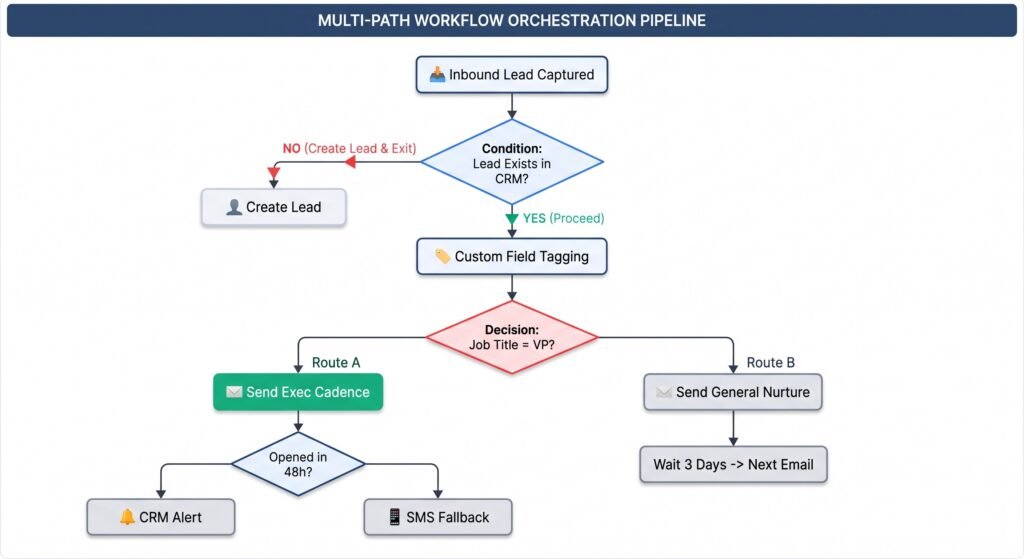
Campaigner’s visual workflow builder is the platform’s primary technical asset—provided you are on the Advanced tier. The canvas allows marketing operations specialists to drag triggers, conditions, delays, and actions into unified workflows.
Unlike basic linear sequencers, Campaigner supports deep branching based on user attributes and behavioral history. For example, you can design a logic flow where:
Overall, our Campaigner review provides a robust foundation for understanding this platform.
From this Campaigner review, you will learn how to optimize your strategies effectively.
In conclusion, this Campaigner review equips users with essential knowledge for success.
Finally, the key takeaways from this Campaigner review will help shape your email marketing strategy.
This Campaigner review serves to clarify the platform’s offerings and user experience.
- An inbound prospect downloads a technical asset (Trigger).
- The system evaluates their custom field for
Company_Size(Condition). - If enterprise-tier, an email sequence is initiated from a dedicated sales executive, and a webhook alerts your internal CRM.
- If the recipient does not open the email within 48 hours, the workflow branches to deliver an automated SMS notification providing an alternate direct link.
The visual builder handles deep logic reliably. However, the interface itself feels utilitarian. It lacks the modern drag-and-drop responsiveness found in newer SaaS platforms, requiring multiple clicks to configure node parameters and save step settings.
2. Industry-Leading Deliverability & Reputation Defender
In this Campaigner review, we delve into the key features that distinguish it from other solutions.
Deliverability is the strongest pillar of Campaigner’s reputation. The platform maintains an infrastructure relationship with major mailbox providers and enforces anti-abuse monitoring across its shared pools.
Our Campaigner review presents a clear picture of its capabilities and limitations.
For organizations running critical B2B outbound and inbound operations, Campaigner provides:
- Full support for native domain authentication: Automated TXT generation for SPF, DKIM 2048-bit keys, and DMARC alignment records.
- Reputation Defender: A real-time verification engine that scrubs incoming signups against active spam trap databases, dormant mailboxes, and disposable domains before they can contaminate your list.
- Dedicated IP pooling for high-volume enterprise senders, isolating your sending reputation from third-party spammers.
Adhering to strict Google bulk email sender guidelines requires complete technical compliance, and Campaigner’s infrastructure enforces these protocols out of the box.
3. Campaigner REST API & Webhook Architecture
The visual automation capabilities, as highlighted in our Campaigner review, can significantly enhance user engagement.
The findings from this Campaigner review will be invaluable for your marketing team.
For organizations that use custom customer data platforms (CDPs) or proprietary databases, Campaigner provides an extensive, well-documented API framework.
Developers can programmatically manage subscribers, query campaign analytics, trigger transactional dispatches, and modify custom attributes in real time. The platform supports standard JSON payloads over HTTPS and provides granular webhook subscriptions, firing events for:
- Email opens and unique link clicks
- Hard bounces and spam complaints
- Subscription status changes
- SMS delivery receipts and inbound keyword replies
For development teams evaluating custom implementations, inspect the official Campaigner REST API documentation for full endpoint specifications and authentication requirements.
4. Audience Intelligence & Granular Segmentation
Campaigner moves beyond static tagging by implementing an RFM (Recency, Frequency, Monetary) scoring model. While RFM is historically associated with retail e-commerce, it maps cleanly to B2B customer lifecycle management:
- Recency: How recently did this enterprise prospect interact with your content or open a product update?
- Frequency: How often does a buying committee member click through to technical documentation or release notes?
- Monetary (Value): What is the projected contract value or seat count tied to the prospect’s company record?
These dimensions allow marketing teams to create dynamic segments that automatically update in real time. If a prospect’s engagement velocity drops below a set threshold, they can automatically transition into an automated re-engagement sequence.
5. Email Design, Reusable Blocks, & Landing Pages
Campaigner includes an updated drag-and-drop email builder alongside a raw HTML code editor for teams that code custom, responsive email templates.
- Reusable Content Blocks: Save custom headers, footers, callout boxes, and disclaimer sections to a central library. Updating a reusable block updates it across every active campaign utilizing that asset, saving valuable production time.
- Dynamic Content Insertion: Inject personalized text, image variations, and custom CTAs based on subscriber segment data directly inside standard templates without cloning campaigns.
- Landing Pages and Forms: While Campaigner includes a native landing page and form builder, this is the weakest component of the design suite. The templates are dated, layout adjustments are rigid, and styling options require custom CSS injections to match modern brand guidelines. Most B2B organizations will prefer using external form engines integrated via API.
Campaigner vs. Major Industry Alternatives
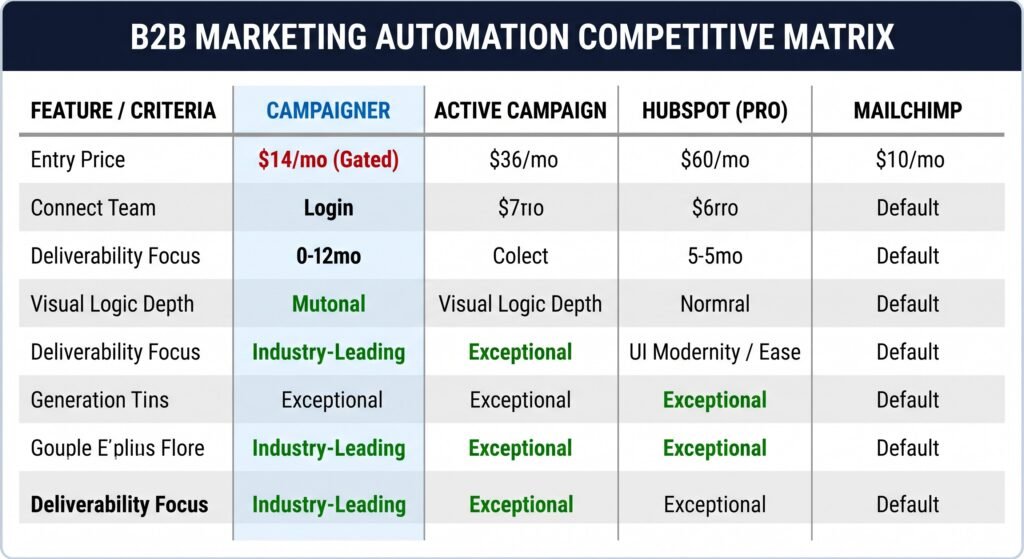
To understand where Campaigner fits in the broader B2B marketing technology landscape, we compared it directly against three primary competitors across key operational vectors.
This Campaigner review aims to empower users with actionable insights for their campaigns.
The results of this Campaigner review will provide clarity for all potential users.
Detailed Alternative Scenarios:
Also, our Campaigner review includes insights into how it stacks up against competitors.
- ActiveCampaign: Better suited for SMBs that require deep native CRM functionality and a modern, fluid user interface without paying enterprise software prices. ActiveCampaign’s automation canvas is more intuitive than Campaigner’s, though Campaigner holds an edge in sheer raw throughput and dedicated IP configurations for massive contact volumes.
- HubSpot Marketing Hub: The gold standard for holistic inbound marketing, tracking leads from anonymous page views to closed revenue. However, HubSpot is exponentially more expensive, requiring thousands in mandatory onboarding fees and hundreds more in monthly software licensing.
- Mailchimp: Ideal for entry-level B2C, creative agencies, and solopreneurs who prioritize ease of design and broad third-party marketplace integrations. Mailchimp falters in complex B2B environments that require sophisticated API customization, conditional webhook dispatches, and dedicated IP isolation.
For a complete architectural teardown of how these tools compare head-to-head on deliverability metrics, read our Campaigner vs Mailchimp comparison analysis.
SoftReviewLab Rubric Breakdown & Technical Scorecard
To eliminate subjective bias, our platform evaluations adhere to a standardized scoring rubric graded across five core operational disciplines on a 1.0 to 10.0 scale.
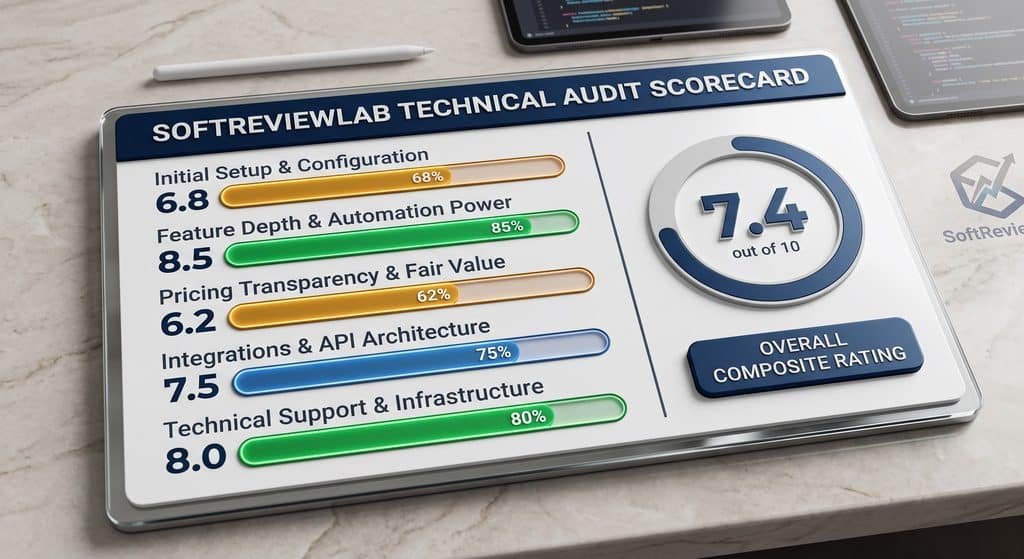
1. Initial Setup & Configuration: 6.8 / 10
The onboarding experience suffers due to two primary friction points: the mandatory credit card requirement to unlock the 30-day trial and the dense, dated organization of the account settings. While domain verification (SPF, DKIM) is clearly documented, navigating the initial contact import, mapping custom fields, and configuring suppression lists feels utilitarian and developer-centric rather than user-friendly.
2. Feature Depth & Automation Power: 8.5 / 10
Once inside the Advanced tier, Campaigner’s operational power is undeniable. The visual automation canvas supports complex conditional branches, multi-step delays, behavioral triggers, dynamic tag management, and integrated SMS actions. The engine handles large volumes of concurrent subscriber states without execution lag.
3. Pricing Transparency & Value: 6.2 / 10
Campaigner scores lowest in our pricing evaluation. Promoting a $14/month entry tier that strips out the platform’s flagship feature (visual automation) creates false expectations for prospective buyers. When accounting for mandatory tier upgrades, separate SMS credit billing, and list-cleaning fees (Reputation Defender), the true total cost of ownership escalates rapidly.
4. Integrations & API Architecture: 7.5 / 10
As our Campaigner review suggests, continuous learning is key in this dynamic environment.
The REST API is clean, comprehensive, and well-maintained, allowing development teams to build custom bidirectional synchronization pipelines. However, Campaigner’s out-of-the-box native app marketplace is noticeably smaller than competitors like ActiveCampaign or Mailchimp, forcing teams without internal engineering resources to rely on Zapier or custom webhook configurations.
5. Technical Support & Infrastructure: 8.0 / 10
Customer support is a standout operational highlight. Unlike platforms that hide human representatives behind unhelpful AI chatbots, Campaigner provides responsive phone and live-chat support with agents who demonstrate a practical understanding of email deliverability, DNS record management, and automation logic.
Unvarnished Pros and Cons
Every B2B software tool has real-world tradeoffs. Here are the unvarnished engineering pros and cons discovered during our technical evaluation of Campaigner.
The Pros: Where Campaigner Excels
- High-Volume Deliverability Architecture: Enterprise accounts benefit from isolated dedicated IP ranges and strict server-level compliance, protecting critical sales communications from shared-pool spam contamination.
- True Multi-Branch Workflow Logic: The Advanced tier visual builder allows for sophisticated, non-linear B2B nurture sequences based on engagement velocity and custom data attributes.
- Unified Email & SMS Orchestration: Build cohesive omni-channel campaigns where SMS acts as an intelligent fallback or direct escalation path within a single automation sequence.
- Reliable REST API & Event Webhooks: Enables seamless integration into custom web applications, SaaS dashboards, and proprietary sales databases.
- Responsive Technical Support: Rapid access to knowledgeable human agents via phone and chat saves operational hours during campaign configuration crises.
The Cons: Where Campaigner Falls Short
- Misleading Entry-Level Pricing: The $14/month Essentials plan gates visual automation workflows, dynamic content, and advanced segmentation behind higher-priced tiers.
- Dated, Complex User Interface: The admin dashboard, navigation menus, and form editors feel a decade old, demanding a steep learning curve for non-technical team members.
- Mandatory Credit Card Trial: Prospective users cannot test the platform without providing billing information upfront, creating friction during early software evaluation.
- Expensive Operational Add-Ons: Continuous list scrubbing (Reputation Defender) and SMS messaging credits add substantial hidden costs to your monthly software bill.
- Weak Native Form & Landing Page Builders: Landing page and lead capture templates are visually dated and lack modern design flexibility, requiring external tools for high-converting B2B assets.
Objective Verdict: Who Should Use Campaigner vs. Who Should Skip It
The primary objective of this Campaigner review is to align this software with the correct operational profile. No software tool is universally ideal; business success depends on matching platform architecture with team capabilities.
The Ideal Customer Profile (Best For)
Campaigner is strictly engineered for:
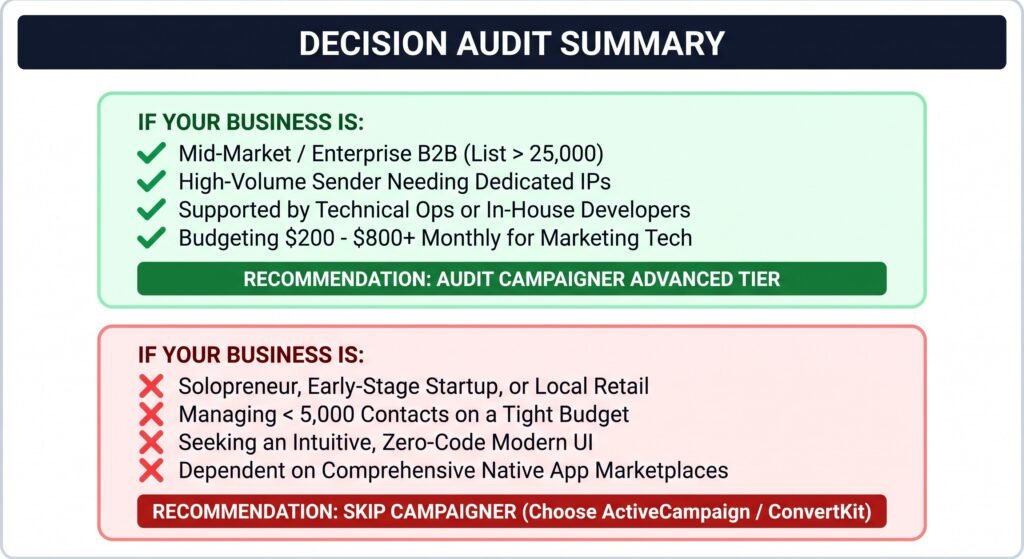
- Mid-Market & Enterprise B2B Teams: Organizations with established subscriber bases (exceeding 25,000 to 50,000 contacts) that need enterprise deliverability controls and dedicated IP routing.
- High-Volume Lead Generation Senders: Companies that run high-velocity outbound and inbound campaigns where sender reputation and proactive list hygiene are paramount.
- Technical Marketing Operations Specialists: Teams with dedicated personnel capable of leveraging raw REST APIs, configuring complex webhook endpoints, and building intricate behavioral logic trees.
Who Should Skip It (Anti-Ideal Customer Profile)
You should completely avoid Campaigner if you fall into any of these categories:
Our detailed Campaigner review ensures you don’t overlook any important features.
Ultimately, this Campaigner review highlights the essential aspects of the platform.
- Early-Stage Startups & Solopreneurs: If your database has fewer than 5,000 contacts, paying for the Advanced tier is financially inefficient. You will achieve better usability and lower costs using platforms like ActiveCampaign, ConvertKit, or Brevo.
- Non-Technical Marketers Seeking Visual Simplicity: If you expect a modern, intuitive, drag-and-drop workspace like Notion or Webflow, Campaigner’s clunky admin interface will cause immediate frustration.
- Teams Looking for a Genuine $14/Month Solution: If your operational budget cannot support upgrading to the $35/month baseline—and scaling to hundreds of dollars as your database grows—do not sign up for Campaigner. The $14 plan lacks the visual automation required for modern digital marketing.
How Campaigner Resolves B2B Workflow Bottlenecks
Campaigner addresses operational bottlenecks through a clear mechanism: behaviorally triggered workflow automation coupled with dedicated sender reputation management.
The insights gained from this Campaigner review can significantly impact your marketing strategy.
Instead of routing all inbound leads into a static newsletter blast, Campaigner’s Advanced tier allows you to deploy state-based workflows. An enterprise lead’s custom attributes (e.g., job role, company revenue, website engagement) dynamically trigger personalized messaging paths. If a prospect clicks a high-intent pricing link, Campaigner’s webhook engine instantly pings your CRM, assigns a task to an account executive, and pauses automated generic nurturing. If an email bounces or shows signs of invalidity, Reputation Defender neutralizes the contact before your global sender score deteriorates.
For complete, unbiased details—including full pros, cons, hidden limitations, and pricing analysis to help you make the right buying decision—read our Full B2B Marketing Automation Platform Hub.
Unbiased Choice Reinforcement: Keep in mind that Campaigner is merely one vetted tool in the enterprise automation landscape. If your organization already operates within an integrated ecosystem like HubSpot or Salesforce Marketing Cloud, or if you can resolve your workflow bottlenecks using free open-source SMTP relays (like Postfix paired with Amazon SES), you may not need an all-in-one commercial platform like Campaigner. Empower your technical leads to audit Campaigner’s 30-day trial against your specific visual workflow requirements before committing your budget.
Step-by-Step Implementation Guide: Auditing Campaigner for Your Stack
If your organization fits the ideal profile and decides to evaluate Campaigner, execute this structured audit protocol during your 30-day trial to verify architectural compatibility before migrating production data:
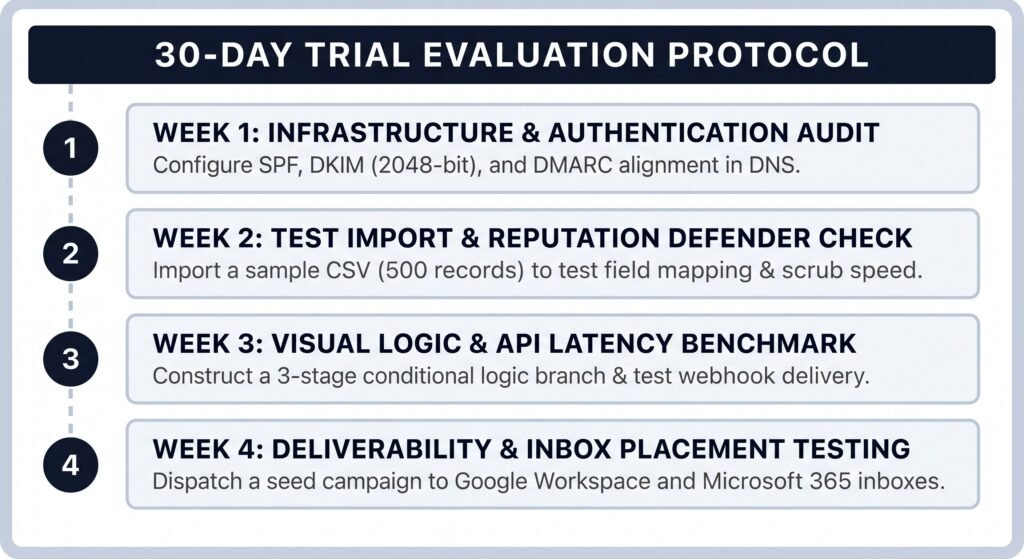
Week 1: Infrastructure & Authentication Audit
- Navigate to your domain’s DNS manager (e.g., Cloudflare, Route 53, or GoDaddy).
- Add the SPF include mechanism specified by Campaigner.
- Generate a 2048-bit DKIM key within the Campaigner admin dashboard and publish the corresponding TXT record.
- Verify DMARC alignment using an external validator to confirm zero authentication failures.
Week 2: Test Import & Data Hygiene
- Export a segmented sample of 500 contacts containing diverse custom fields (e.g.,
Industry,Account_Owner,Lead_Score). - Execute a test import in Campaigner to verify field mapping speed, error handling, and tag assignment.
- Activate Reputation Defender on the import batch to observe how the platform categorizes high-risk, invalid, or disposable addresses.
Week 3: Automation Logic & Webhook Testing
This Campaigner review will help you navigate the complexities of email marketing tools.
- Open the visual automation builder and create a 3-stage workflow containing at least one conditional branch (opened email vs. did not open) and one delay block.
- Subscribe a test endpoint (using a free tool like Webhook.site) to Campaigner’s webhook notifications.
- Trigger the workflow with a test subscriber and measure the delivery latency between email interaction and webhook dispatch.
Week 4: Deliverability Verification & Final Decision
- Set up seed mailboxes across Google Workspace, Microsoft 365, and major free webmail providers.
- Dispatch a realistic B2B campaign draft to the seed list.
- Inspect raw email headers in the receiving inboxes to confirm that authentication passes (
PASSon SPF, DKIM, and DMARC) and that the campaign landed in the Primary inbox rather than Spam or Promotions.
For a deeper exploration of sender scores and inbox placement optimization, refer to our comprehensive email deliverability and inbox placement guide.
Frequently Asked Questions (FAQ)
Does Campaigner have a free plan?
No. Campaigner does not offer a perpetual free tier. They provide a 30-day free trial, but users must enter a valid credit card during account registration. If the trial is not canceled before the 30-day period expires, your card will automatically be billed for the selected subscription tier.
Is Campaigner’s $14/month Essentials plan sufficient for B2B email marketing?
No. The Essentials plan lacks visual multi-path automation workflows, dynamic behavioral segmentation, and advanced API tools. For B2B organizations that require conditional lead nurturing, the Advanced tier ($35/month minimum) is the true functional entry point.
How does Campaigner compare to Mailchimp on deliverability?
Campaigner provides superior deliverability controls for high-volume senders. While Mailchimp routes most accounts through large, shared IP pools with strict, automated compliance policing, Campaigner offers dedicated IP allocations and integrated list cleaning (Reputation Defender), making it better suited for high-volume B2B outreach.
In summary, this Campaigner review can guide you in optimizing your email strategies.
Does Campaigner support SMS marketing?
Yes. Campaigner natively supports two-way SMS messaging that can be synchronized directly into visual email automation workflows. However, SMS messaging credits are not included in the base subscription plan and must be purchased separately.
Can I build custom CRM integrations with Campaigner?
Yes. Campaigner provides a complete RESTful API supporting CRUD operations for contacts, lists, campaigns, and custom fields, alongside real-time event webhooks for bi-directional synchronization with external CRMs.
Our comprehensive Campaigner review ensures that you have all the necessary information to make an informed decision.
When considering a new platform, this Campaigner review should be your starting point.
Before you make a decision, our Campaigner review provides a thorough analysis of its capabilities.
In our Campaigner review, we assess the platform’s strengths and weaknesses critically.
Still shortlisting?
Filter every review by category, business size and price to find the tools built for a business like yours.